Hotel Transylvania Strives to Restore Profitability
Case Type: improve profitability; reduce cost.
Business Concepts Tested: Cost analysis; Brainstorming; Math calculation.
Consulting Firm: McKinsey & Company first round full time job interview.
Industry Coverage: tourism, hospitality, lodging.
Quantitative Difficulty: Hard; Qualitative Difficulty: Hard; Overall Difficulty: Hard
Case Interview Question #01385: Our client is Mr. Dracula, the Founder and CEO of Hotel Transylvania. Hotel Transylvania is a budget hotel chain based in Romania with 800 locations across Europe,  with 75% owned by franchisees and 25% owned by the company. The hotels are organized under six different brand names, which are popular among young travelers and cash-strapped business travelers alike. Though the rooms are small and spartan, the Hotel Transylvania chains are renowned for bed comfort and friendly service. Customers are loyal to specific brands and TripAdvisor has several discussion threads featuring arguments about which brand is “best.” A particular point of pride of Hotel Transylvania is its highly de-centralized, hands-off management team, so these conversations are often used by brand managers to help evaluate the marketplace.
Over the last three years, profit has been dropping for Hotel Transylvania. Though the hotel and hospitality industry in general has been experiencing softness and oversupply, Hotel Transylvania’s profit has been declining faster than others’. Mr. Dracula has hired a McKinsey team to help restore profitability. How would you go about it?
Note to Interviewer: Pause here and ask the candidate if he/she needs any further clarification on the above case prompt. This pause is really just about clarification on the information so far, as the next question (see Question #1 below) is far more specific.
Possible Answers:
1. Additional Information
a. Guidance for Interviewer
There is an optional twist in this case: when asked for a couple minutes to sketch out a framework for this case, the interviewer should feel free to say no (or yes, but that you want to hear the candidate’s thoughts out loud as the framework is developed). It’s a good way to shake someone out of a rhythm and get him/her used to going with the flow.
b. Additional Clarification about the case
• One of the key drivers of Hotel Transylvania’s costs is purchases of washable room items, particularly towels and bed sheets.
• Towels and sheets are purchased as sets (each room has one set of towels and one set of sheets) and the price of each set is negotiated at the corporate level with its supplier, which has several factories spread across Europe.
• When towels and sheets are ordered, the general manager of each hotel contacts Hotel Transylvania’s exclusive distributor, which orders the items from the factory and delivers them to the hotel.
• There are several designs of towels and sheets used across brands, and not every brand (or even hotel) is consistent with its purchases. Each set costs the same, however.
• There is no need to worry about FX (foreign exchange rates,) as all costs are in euros.
• Hotel Transylvania’s exclusive distributor charges a set fee for each order placed.
• Towels and sheets are designed to last at least three years, but Hotel Transylvania recommends replacing every two years.
• A towel set includes two washcloths, three hand towels, two bath towels, and a bath mat.
• A sheet set includes four pillowcases, a fitted sheet, a top sheet, and a duvet cover.
2. Detailed Analysis
Question #1. The McKinsey team has determined that one of the key drivers of Hotel Transylvania’s costs is purchases of washable room items, particularly towels and bedsheets. Towels and sheets are purchased as sets (each room has one set of towels and one set of sheets) and the price of each set is negotiated at the corporate level with its supplier, which has several factories spread across Europe. When towels and sheets are ordered, the general manager of each hotel contacts Hotel Transylvania’s exclusive distributor, which orders the items from the factory and delivers them to the hotel. Can you brainstorm some ways that Hotel Transylvania could save money on its towels and sheets orders?
Solution:
This should essentially be a list of suggestions on how to save money.
a. Towels & Sheets (materials)
• Use cheaper materials
• Include less in towel set / use less material
• Eliminate duvet cover or top sheet in sheet set
• Use longer than two years
b. Ordering process
• Standardize towel and sheet design
• Coordinate buying decisions among local chains
• Eliminate distributor / find new one
• Change supplier
• Lock in long-term contracts for a discount
After the list is completed, ask the candidate to choose the best two or three ideas that should be pursued first. Push back on the top suggestion and force him/her to defend the choice.
Question #2. As it turns out, the two most viable options to save money are standardization of design and moving to a Chinese supplier. Can you tell me what the savings would be in year one and two if those changes are implemented?
Additional Information:
Key data points are provided below, but don’t give any of them until it is specifically asked for.
• For purposes of this analysis, the life of the sheets and towels can be ignored.
• Price of Towels and Sheets
– Towels: €10 per set (including distributor shipping)
– Sheets: €30 per set (including distributor shipping)
• Total purchases last year: €50M
• Purchase quantity breakdown: Half towel sets, half sheet sets
• Standardization of design: 5% savings per set (based on original supplier prices)
• Standardization design cost: €10M
• Chinese supplier discount:
– Towels: €3.00 per set
– Sheets: €5.50 per set
• Additional distributor shipping charges (Chinese supplier):
– Towels: €0.50 per set
– Sheets: €1.00 per set
Solution:
Sample calculation
a. Purchase Quantity
Let last year’s purchase quantity of towel sets and sheet sets be Q
Purchase of towels = Q * €10 per set
Purchase of sheets = Q * €30 per set
Total = €10Q + €30Q = €40Q = €50M
Solve for Q, Q = 1.25M
b. Price of Towels and Sheets if switching to a Chinese supplier
– Towels: €10 – 3.00 discount + 0.50 shipping = €7.50 per set
– Sheets: €30 – 5.50 discount + 1.00 shipping = €25.50 per set
c. Total purchase
– Towels: €7.50 per set * 1.25M = €9.375M
– Sheets: €25.50 per set * 1.25M = €31.875M
– Total = €9.375M + €31.875M = €41.25M
d. Saving from standardization of design
€50M * 5% = $2.5M
e. Table of Calculation
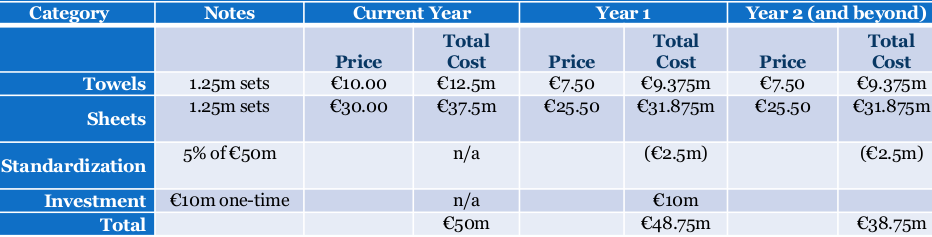
**Note that the 5% price drop due to standardization of design could also be incorporated into the price above, which would make the price of towels €7.50 – €10*5% = €7.00 and the price of sheets €25.50 – €30*5% = €24.00
f. Alternative way of calculation
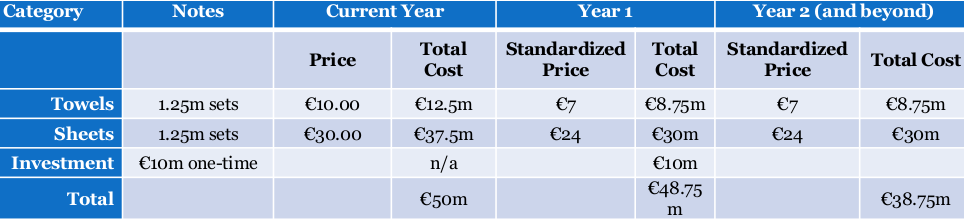
g. Cost Savings
– Year 1: €50M – €48.75M = €1.25M
– Year 2: €50M – €38.75M = €11.25M, €11.25M/€50M = 22.5%
Insight: Not only would this change (standardization of design and switching to a Chinese supplier) increase profits, the payback period is less than a year and by year two there would be a cost savings of over 20% on a key cost item!
Question #3: What are the risks associated with this strategy (standardization of design and switching to a Chinese supplier)?
Solution:
Possible risks include:
• Brand confusion / diminished differentiation
• Could a decentralized team really standardize a design that quickly?
• Enforcement of new ordering mechanism
• Political risk of ordering from a Chinese supplier
• Inferior materials
• Transportation time / higher variable cost
• Distributor / supplier relationship
Question #4 (extra credit) We’ve also discovered that one-third of the franchisees are replacing their sheets and towels every year
rather than every two years. Why might that be?
Solution:
This part of the case tests the candidate’s skills of soft brainstorming. After the candidate gives a list of possible reasons, tell him/her that the real cause is that minerals in water diminish the quality of the towels / sheets.
Question #5. If the necessary water filters are installed, how many less sets of towels and sheets will be purchased each year? How much will the company save per hotel, assuming the original towel and sheet costs (€10 per towel set and €30 per sheet set)? Assume that half of the company-owned hotels and half the franchisees replace their sets each year (i.e., a two year cycle).
Solution:
The easiest way to do this is to consider the total number of hotels, which is 800, with 75% owned by franchisees and 25% owned by the company.
– # of franchisees owned hotels = 800 * 75% = 600
– # of company owned hotels = 800 * 25% = 200
Therefore, one-third of the franchisees, or 200 hotels must be replacing sets every year and the rest 600 hotels must be replacing sets every other year (this can also be thought of as 300 hotels per year). The 200 ‘always-replacers’ represent 40% of the purchases every year.
– Total # of hotels replacing every year = 200 + 300 = 500
– Percentage of always-replacers = 200/500 = 40%
40% of 1.25M sets is 500,000 sets. Divide this by two (the equivalent of moving from an every-year to an every-other-year cycle) to yield 250,000 sets of both towels and sheets that can be saved every year.
Using the original price structure (€10 per towel set and €30 per sheet set) and assuming that a water filtration system lasts ten years, how much is the maximum you would be willing to pay per hotel to install the water filtration system? The discount rate is zero.
– Savings: 250,000 * €10 + 250,000 * €30 = €10M overall per year, €100M over the course of the water filtration system.
– Savings per hotel: €100M / 200 hotels = €500,000 per hotel
Question #6. If the water filtration system costs exactly €500,000, should it still be installed?
Solution:
Either a “Yes” or “No” answer to this question is OK, as long as the candidate can rationalize his/her answer.
• YES: better standardization, higher quality drinking water, will also clean other items.
• NO: lower prices of towels / sheets make this less cost effective, perhaps government will do it.
3. Conclusion & Recommendation
Recommendation
• To increase profits, the client should standardize their washables design and switch to a Chinese supplier.
• Install water filtration system to further decrease the need for towel and sheet change.
Rationale
• Increased profit of over €10M per year by year two.
• Less than one year payback period of initial investment.
• Possibility of more savings by installing water filtration systems or eliminating distributor.
Potential Risks
• Design coordination
• Brand confusion
• Quality of materials from Chinese factory.
• Redundant filtration system if local government steps up.
Next Steps
• Begin designing new washables and breaking contract with original supplier.
• Research water filtration systems.