L’Oreal to Improve Profitability of Hair Product Division
Case Type: Improve Profitability.
Consulting Firm: Health Advances first round full time job interview.
Industry Coverage: conglomerate; cosmetics, beauty products.
Case Interview Question #01366: Our client is L’Oreal S.A. (Euronext: OR), a large European conglomerate headquartered in Clichy, Hauts-de-Seine with a registered office in Paris. L’Oreal is the world’s largest cosmetics company and has developed activities in the field concentrating on hair color, skin care,  sun protection, make-up, perfume, and hair care.
The client L’Oreal has many product divisions including home cleaning supplies, pet care, perfume, skin care, and hair products. Their hair product division is made up of five separate companies and is the least profitable division. The CEO of L’Oreal has brought in our consulting firm to examine their hair product division. Also, he would like you to offer suggestions for improvement. How would you go about it?
Additional Information: (provide to candidate upon request)
1. Client Goal
– The client L’Oreal wants to increase profits of the hair product division.
2. Hair Product Division
– Operates all over Europe and is made up of 5 subsidiaries.
– These 5 companies fall into the categories of hair care (multiple shampoo and conditioner brands), hair styling (gels and styling creams), and hair transplants (surgical treatment for baldness).
– Subsidiaries in the first two categories (hair care, hair styling) sell products, and companies in hair transplants category provide clinical service.
3. Hair Transplant
– Hair transplant is a surgical procedure where hair is transplanted from another part of a patient to the scalp as a way to treat baldness.
Possible Answers:
1. Suggested Framework
Question #1: What factors should be considered?
Possible Answer:
(1) Profitability (segment for each company)
* Revenue
– Product/Service Price
– # of product/service
* Cost
– unit cost per product/service
– # of product/service
(2) Marketing
* Brand Positioning
* Channels
(3) Product/Service
* Hours for operation/Appointments
* Locations
* Service Quality
(4) Market
* Market Size
* Market Trend
– Growth
– Regulation
* Competition
2. Profitability Analysis
Since the client L’Oreal has recognized the issue of profitability underperformance in their hair product division, the candidate should ask for information about the profitability of the hair product division.
At this point the interviewer should provide Exhibit 1.
Exhibit 1: Subsidiary Companies in Hair Product Division

Question #2: What can be interpreted from Exhibit 1?
Possible Answer:
– Hair Care and Hair Styling companies seem to be operating with healthy margins.
– The Hair Solutions (HS) seems to be struggling although the other hair transplant subsidiary company Fountain of Hair (FoH) is profiting.
Conclusion: Underperformance of the hair product division could be attributed to Hair Solutions (HS).
Question #3: Why is HS underperforming comparing with FoH?
Possible Answer:
* External factors (less likely since two subsidiaries are both in hair transplants)
- Hair Transplant Market
- Market Share
- Competition
- Growth Trends
* Internal factor (more possible)
- Low Revenue (Key issue here)
- Price
- # of services
- High Cost
3. FoH Underperformance
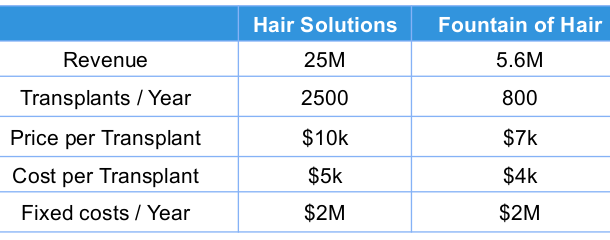
The CEO of L’Oreal has set up a meeting with the heads of FoH and HS. The head of HS says that her company specializes in high end clients and the head of FoH says that his company specializes in low end clients. Both say the potential market for hair transplants is about 3,500 transplants per year. They also provide company information as requested (show Exhibit 2)
Exhibit 2: Hair Transplant Company Comparison
Question #4: What can be concluded from Exhibit 2?
Possible Answer:
Interpretations of Exhibit 2
– The candidate should note that while HS is the higher priced company, it has much more sales than FoH.
– Additionally, costs are relatively the same between the two companies.
– Total sales (2,500 + 800 = 3,300) of the two companies have covered ~95% of the target hair transplant market (3,300/3,500 = 94.3%).
Question #5: Why does HS have more customers than FoH? (Ask the candidate to brainstorm)
Possible Answer:
* Product/Service Comparison
- Product/Service Quality
- Price as surrogate for quality
- Brand reputation
* Customers
- Preference
- Perception
Question #6: How would you test these reasons?
Possible Answer:
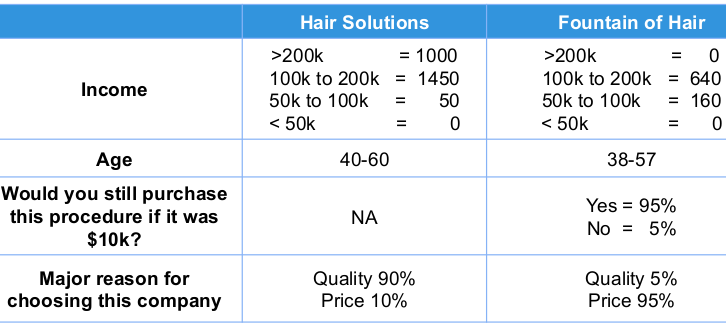
Customer survey or otherwise ask the customers (provide Exhibit 3).
4. Customer Survey
Exhibit 3: Hair Transplant Customer Survey
Question #7: How would you interpret Exhibit 3?
Possible Answer:
- Total customer base skews from the $100k to $200k income range and above. Very few customers are below $100k.
- Customers of HS and FoH are mostly the same; the majority of customers make over $100k and are the same age.
- More customers use HS because it is perceived as of higher quality and the majority of customers can afford that premium.
- The majority of budget customers would still pay $10K or more for a hair transplant.
Conclusion: A good candidate would question if two companies are actually necessary. A single company charging $10k would still capture the same number of customers except for the 5% of FoH customers (800*5% = 40 customers).
At this point, the interviewer can move to the conclusion of the case.
5. Summary of Case
Question #8: The CEO of L’Oreal has asked for our findings and recommendations. What would you tell him?
Possible Answer:
(1) Recommendation / Rationale
I recommend that our client L’Oreal merge the two hair transplant companies. This would maintain the majority of our customers, and lead to an overall increase in profits as customers switch from the low margin ($3k) budget company to the higher margin ($5k) company.
FoH has been struggling due to a mismatch between company strategy and customer need. Although HS and FoH were intended to meet the needs of two customer segments, there is only one pool of high end customers who mostly value the perceived high quality of HS. A merger would better align the hair transplant portion of our client’s business.
(2) Potential Risks
* Reorganization costs and implementation.
– As with any merger, restructuring of the two companies will have significant costs associated with implementation.
* Employee layoff issue.
– As the merger happens, potentially, a sizable number of employees will be laid off, generating some publicity risks for the conglomerate.
* Loss of greater customer base than estimated.
– A major assumption is that if FoH is closed, the majority of customers will switch over to HS. A smaller than expected switch would allow for the entry of a budget company.
(3) Next Steps
* Marketing to convert FoH customer base.
– In the near term HS should try to convert as many of the FoH customer base (estimated at 800) to use their procedure to increase overall profits.
* Explore a low cost budget procedure.
– A significant problem with the operations of FoH was that the costs associated with a budget hair transplant procedure are very similar to the HS procedure. In the long run, developing a lower cost procedure with similar or greater margins could be well received by the potential FoH customer base and would bolster profitability.