Quaker to Increase Profitability of Rice Cakes
Case Type: improve profitability; finance and economics.
Consulting Firm: FTI Consulting first round full time job interview.
Industry Coverage: food and beverage.
Case Interview Question #01365: Your client The Quaker Oats Company, known as Quaker, is a large food manufacturer based in Chicago. The company started as an oat mill in 1901 and has expanded into numerous areas, including other breakfast cereals and other food and drink products. Quaker Oats Company has been owned by  American food and beverage conglomerate PepsiCo (NASDAQ: PEP) since 2001.
In the United States the client Quaker Oats Company has a dominant market share in rice cakes. Recently, the CEO of Quaker Oats Company wants to increase the profitability of their rice cake product line. They are trying to decide whether to raise or lower the price of Quaker rice cake products. What are some of the things you would think about in helping them make a decision? What would you recommend they do?
Possible Answers:
This is a specific business case with key strategic elements. This case could go to any type of candidate – undergrad, MBA, advanced-degree – but the expectations for the answer would be different. MBAs would be expected to offer an answer with more depth and understanding of business concepts. Undergrads and advanced-degree candidates would still be expected to hit on basic themes, but they might get a little more prompting from the interviewer.
Candidate: You said they want to increase profitability on the rice cake product line. That brings us back to the old profit equation: profit = revenues – costs. Before jumping headfirst into the pricing question I’d want to take a look at the basics: costs and revenues. Is there any leverage on the cost side? In other words, can they reduce their cost structure (manufacturing, selling, distribution, G&A, etc.) so that they can increase profitability by operating more efficiently instead of passing a price increase on to the consumer?
Note: Instead of taking the bait, the candidate backs up, identifies a useful framework (profitability framework: profit = revenues – costs), and poses a couple of highly relevant questions.
Interviewer: That’s a good fundamental question. But both the client and our consulting firm have examined the cost structure of rice cakes extensively, and it appears that they are currently operating pretty efficiently. In fact, we did a large cost reduction study for them about 18 months ago and successfully removed all the “fat” from the operation. So the cost side provides no leverage in increasing profitability.
Note: The interviewer answers the candidate’s question directly and helps focus the discussion further.
Candidate: Okay, then we’ll focus on the revenue side, which is basically price and volume. Has the company examined attempting to increase volume without affecting price, through increased promotions or more shelf space, for example?
Note: The candidate quickly jumps to the second piece of analysis and identifies a second relevant (and simple) framework: revenues = price x units.
Interviewer: The client company feels that it has saturated the channel (i.e., shelf space is not a problem) and that it is getting all the possible mileage out of both consumer and trade promotions. Volume, therefore, will not be easy to increase without playing with price.
Note: Okay, so the easy things have been ruled out.
Candidate: So price really is the only lever left. Well, okay. Then we need to figure out what the optimal price for rice cakes is. In other words, we need to set the price of rice cakes at the point where the profit is greatest.
Note: One trick to buy a little more time in the case interview – although you should be careful to not overuse it – is to give a quick summary of the situation or to repeat/confirm your understanding of the information conveyed by the interviewer.
Interviewer: Good. So how would you go about figuring that out?
Candidate: Well, in theory, each price point has a certain volume associated with it – that’s called the rice cake demand curve. In general, there will be higher volume at lower price points, and lower volume at higher price points.
To maximize revenue you would set the price at the point at which P*Q was greatest. So for example, if you could set the price at either $1 or at $2, and the demand associated with each price point was 500 units and 100 units respectively,then you’d set the price at $1. Because even though the price is lower, the total revenue is greater at the $1 price point. Graphically, it would look something like this:
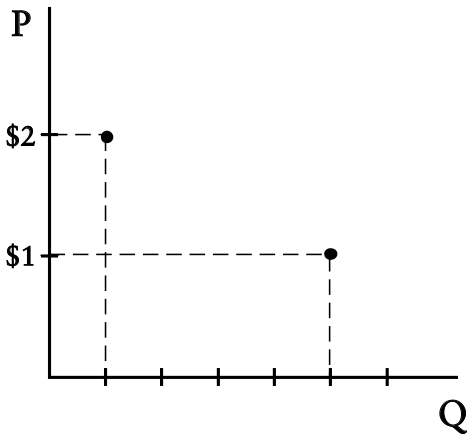
Note: It’s often an excellent idea to pull out pen and paper and draw a graph or figure if it helps you answer the question. Consultants really do like to use graphs, frameworks, and other visual tools. In this case, it would also be good to write out the revenue equation on the same sheet of paper. The candidate doesn’t mention “price elasticity”, but this is a basic concept that affects the overall revenue implications of the pricing strategy.
Interviewer: Well, that’s a good start. But the company doesn’t want to maximize revenue, necessarily. It wants to maximize profit. How does that change your answer?
Note: Interviewers love to change the focus slightly or alter the assumptions to see whether you really understand the implications of your answer. If you do use a graph or other device, you can almost expect that the interviewer will ask you questions about how the chart would change under different circumstances.
Candidate: Right. Well, the concept is the same – except that, to figure out the maximum profit, you’ll have to incorporate information about costs. In other words, you’ll need to subtract the costs from the revenues. If you want to think about this graphically, put profits along the y-axis and price along the x-axis. Assuming this is a relatively typical product, with marginal costs of production that fall and then increase, you’ll get a parabola like this.
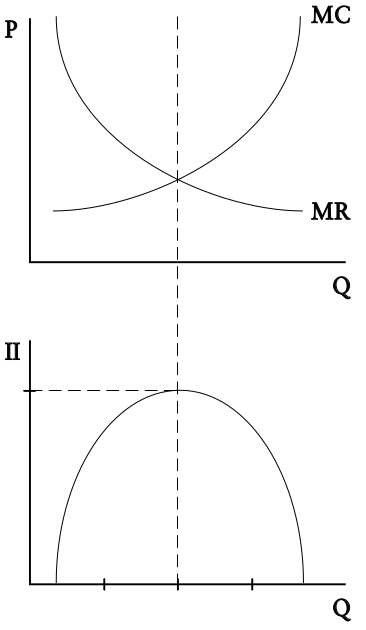
The maximum profit on the product comes at the apex of the parabola. This marks the point at which the marginal cost of production equals the marginal revenue from each sale. Up to that point, you’ve been getting additional profit for each unit sold. To determine exactly where this point would be, you’d have to figure out your marginal cost curve. This should be possible if the client has good cost accounting systems in place. Sincewe’re presumably dealing with some level of fixed capacity, the costs will likely rise as you try to squeeze more production out of the plant.
Note: Again, graphs can help you explain your answer to your interviewer. If you do use them, it’s a good idea to give a brief explanation of what you’re drawing and the implications.
The trickier part is to determine the revenue side of the picture. This depends in large part on the behavior of your consumer. As we’ve already discussed, as the price for the rice cakes goes up, the revenue per cake rises, but the units sold will likely fall. How fast this effect occurs (i.e., the elasticity of demand for the product) will determine the degree to which you can raise the price.
Note: The candidate has done a really good job of walking through a microeconomic analysis of how to maximize profits. Although she hasn’t gone into a great level of detail, she has explained the basic concepts in terms that a client can understand.
Interviewer: That’s an excellent textbook analysis of the problem. But now let’s put ourselves out there in the marketplace. What happens if, based on your analysis, you jack up the price significantly?
Note: The interviewer may or may not ask you to explicitly discuss real-world concerns as part of your analysis. Whether or not you’re asked, it’s often a good idea to keep these issues in mind. Remember, the most elegant academic analysis won’t mean diddly to your client if they think you haven’t understood the reality of their business.
Candidate: Well, assuming we’ve done a careful job analyzing the costs and consumers, profits should go up. Setting aside the question of whether we’ve done our analysis correctly, the other thing I’d be most concerned about is the competitive response to our moves. If we really are the dominant market player, we probably have some ability to set prices. However, our competitors will likely have a response. They may follow our price lead, or they may choose to compete against us on price or other aspects. As our profits go up, we can expect others to be more interested in the market and to try to compete with us more aggressively. Their success at this will depend in large part on exactly how much market power we have.
Interviewer: Good, well that’s certainly something we’d want to look at in our analysis as well.
Possible Bad Answer 1:
Candidate: Definitely don’t raise the price! This is another case of the manufacturer trying to milk the consumer, and at some point, the consumer will rebel! This is exactly the behavior by manufacturers that put generic brands on the map. And lowering the price just erodes the value of the product in the consumer’s mind. They should just hold price steady and think of some other way to improve profits – like lower costs or something.
Note: Uh-oh! The interviewer is thinking that this candidate is really a consumer activist – and not a very bright one at that!
Interviewer: Are there any cases you can think of where a price increase would be justified?
Note: The interviewer prompts the candidate to try to get her back on track.
Candidate: Well, sure. I mean manufacturers have to make money, right? So they should be able to raise their prices at the rate of inflation. No more, no less.
Interviewer: I see….
Possible Bad Answer 2:
Candidate: Well, to increase profits you’ve got to raise the price. That way, the sales price will be greater than the cost, and profits will go up. Or, wait . . . let’s see. How about if I draw a demand curve and figure this one out. Now, if the demand goes up, the price will go up. So, I’ve got to get the demand up, so there are several things to do here. You could advertise the product, you could do some other promotions, you could have a study done showing the health benefits of rice cakes. All these things would probably increase consumer demand for the product and thereby raise the price.
Note: This is a sincere goof. The candidate immediately jumps on a solution (raise prices), then realizes that she hasn’t hit on the answer. She backs up, twists around, struggles to put a framework in place, and ends up in a mess. The lesson here: if you aren’t really sure of what you want to say, avoid the bait! Instead of jumping into a solution, it’s far better to gather more information, or, alternately, to lay out a process for reaching the answer. Also, unless you’re really familiar with a specific tool, you’re probably better off not trying to use it. We guarantee you: it will be awfully hard to knock the rust out of your memory in the heat of a case interview.