Wally’s Wire to Increase Profitability from Existing Businesses
Case Type: Increase Profitability; Industry Analysis.
Consulting Firm: Compass Lexecon first round full time job interview.
Industry Coverage: consumer electronics, home appliances, semiconductors.
Case Interview Question #01270: The year is 2016. Our client, Wally’s Wire Factory, is an American electronics manufacturer that makes electronics cables. Like most players in the industry, the client Wally’s Wire Factory makes a large range of electronics cables, wires, connectors, converters, and other basic electronics extras.  Headquartered in Benton Charter Township, Michigan, the company is consistently ranked as one of the world’s largest electronics cable makers by units sold.
The client Wally’s Wire Factor has a steady stream of business and has little desire to expand into new products. Recently, the newly appointed CEO of Wally’s Wire Factory has hired your consulting firm to help increase profitability from its existing businesses. How would you go about the case?
Possible Answers:
1. Case Overview
This profitability case tests a number of qualitative skills including reading charts and drawing conclusions from visual data. The case also tests a candidate’s understanding of pricing dynamics and ability to form data-driven hypotheses. Though this case does not have a significant quantitative component, candidates will run into difficulty presenting the discrete elements of their synthesis if they are unstructured.
2. Additional Information: (to be provided when requested by candidate)
A. Market
* Wally’s Wire Factory is the leader of an established mature industry that is growing at the rate of GDP.
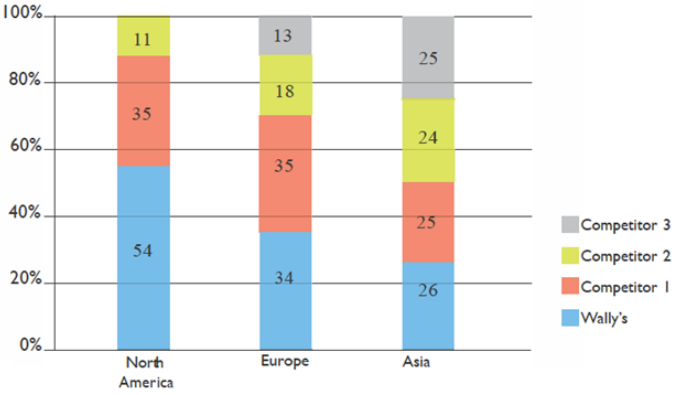
* Market share: provide Exhibit #1 and #2 below.
B. Customers
* The client’s customers are mainly IT departments and retail businesses, but there is a sizable number of technology minded individuals who make direct purchases as well.
C. Competition
* There are significant barriers to entry, so there has been no new competitors in the past 5 years, and Wally’s projects it would take 2-3 years for a new competitor to enter.
* Competition varies significantly by region.
D. Products
* There is a range of higher and lower end products, and margins vary considerably by product line.
Exhibit #1. Wire Market Share Data, 2011
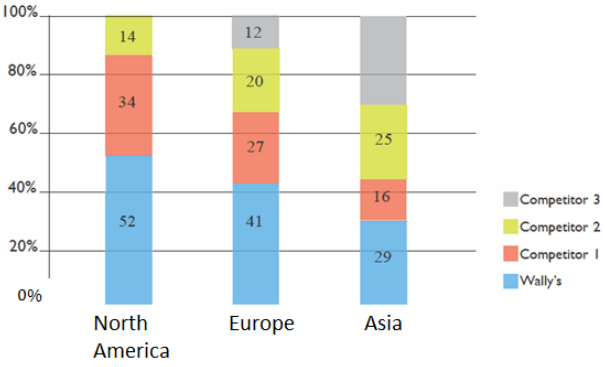
Exhibit #2. Wire Market Share Data, 2016
E. Based on Exhibits #1 and #2, ask the candidate the following questions:
* What happened over the past five years?
* In which market are we best able to increase profitability from existing businesses?
* How should we approach this?
3. Detailed Analysis
Question #1: What happened over the past five years?
Possible Answer:
* Our position in North America has grown further, possibly due to weak buyer power since firms are unable to exert much control as our product is a small component of their costs. It is probably the main buyer, with sales to retail firms being a smaller share.
* Competitor 1 has grown considerably in Europe, mainly at our expense. Given the size of their growth, it is likely that they have reduced prices, which does not bode well for us since we may need to lower prices as well. We may be forced to innovate and cut our own costs
* Competition has become fierce in Asia. Competitor 1 has grown at the expense of competitor 3. Since all firms are splitting profits, late stages of pricing parity are likely settling in. Retail is probably the biggest buyer. Since they shop based on price, as our product is an expensive input, industry profits are eroded.
* Note we cannot say anything about market growth since we are only given market shares.
Question #2: In which market are we best able to increase profits from existing businesses? How should we approach this?
Possible Answer:
* It is unlikely that we can increase profitability in Europe and Asia since our product is being commoditized.
* There is scope to increase profitability in North America.
* Since margins vary by product line, we need to start there and understand causes of variations.
Exhibit #3. Patterns in Gross Margin Variation (North America 2016)
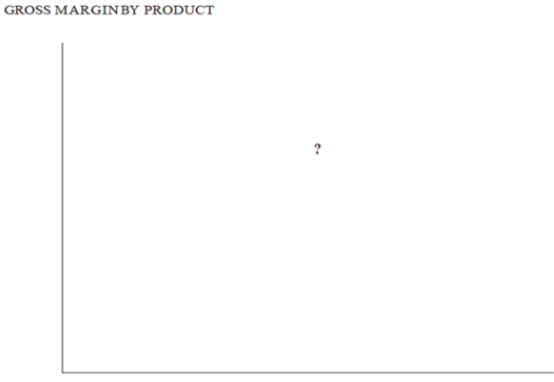
Note: to be provided after market share questions are addressed
Question #3: we want to look at the North American market and understand variations in margins across products. We plot gross margin by product on the y-axis (see Exhibit #3). What variable(s) might we want to plot on the x-axis?
Possible Answer:
* Since we do not face extreme competition in North America, there may be room to increase profits by capturing value through pricing. Therefore we should check how gross margins vary by product price elasticity.
* There are other reasonable answers.
* A strong answer should come with the possibility for some strategic recommendation based on data. For example in addition to naming the axis, the candidate should explain at least one data pattern that comes with a recommended course of action.
Question #4: If we choose to chart price elasticity on the x-axis (see Exhibit #3), what kind of pattern might we expect?
Possible Answer:
* Products with high price elasticity normally have the lowest gross margins, because products across companies are close substitutes and consumers use price when shopping.
* Products with low price elasticity have relatively high gross margins because products do not substitute well, and consumers are shopping based on different feature offers.
* The scatter plot should therefore have a clear downward trend, if the above were to hold true.
Question #5: What kind of pattern would indicate considerable room for increasing profitability?
Possible Answer:
Any scatter plot where we do not see a clear downward trend would indicate considerable room for increasing profitability through price adjustments.
Exhibit #4. Patterns in Gross Margin Variation (North America 2016)
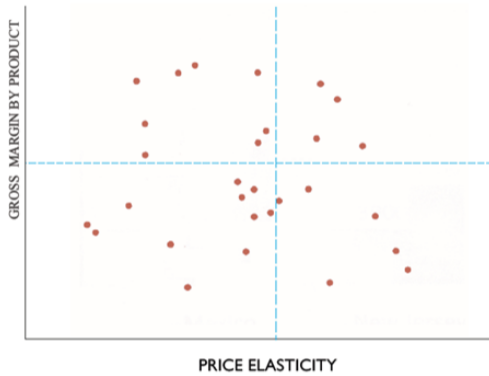
Question #6: after plotting price elasticity vs. gross margin by product, we produce the chart above (see Exhibit #4). There appears to be little correlation between price elasticity and gross margin. What do you conclude based on the chart?
Possible Answer:
* Should raise prices on products in the lower left quadrant, since we can substantially increase margin without suffering share losses, because products have inelastic demand with respect to price.
* We should be willing to cut prices on products in top right quadrant, since we can substantially increase our share with only slight losses of gross margin because of high price elasticity.
* Revenue will increase in top left quadrant through price, and in top right quadrant through quantity.
4. Case Closing
Question #7: Can you provide a final recommendation to the client?
Possible Answer:
* We are unlikely to increase profitability in Europe and Asia since our product is being commoditized.
* We can increase profitability in North America, our strong hold.
* Since there isn’t extreme competition in North America, we may be able to increase profits through price.
* After looking at price elasticity and gross margins by product, we determined that it is best to increase prices in products with low price elasticity and gross margin, and lower prices in products that have high price elasticity and high margins.