Boston Fruit Cart Vendor to Increase Profit by $1000
Case Type: increase profits; new product.
Consulting Firm: FTI Consulting first round full time job interview.
Industry Coverage: small business and startups; retail.
Case Interview Question #01267: Boston is the capital city and most populous municipality of the Commonwealth of Massachusetts in the United States. The city proper covers 48 square miles (124 km2) with an estimated population of 685,094 in 2017, making it also the most populous city in the New England region.  The city is the economic and cultural anchor of a substantially larger metropolitan area known as Greater Boston, a metropolitan statistical area (MSA) home to a census-estimated 4.8 million people. As a combined statistical area (CSA), this wider commuting region is home to some 8.2 million people.
For this case, let’s say you have a long-lost uncle, and he is a fruit cart vendor at a street corner in downtown Boston. He sells fresh fruit only on weekdays to morning and evening commuters, as well as downtowners going on lunch breaks. Your uncle knows that you are a management consultant, and he thinks you might be able to make his business more profitable. He wants to increase his profit during this summer by 10%, which would be $1,000 over last year’s profits, and he will plow these profits back into the business.
In order to do this, your uncle wants to expand his fruit cart into selling fresh vegetables. He is known for having high-quality fresh fruits, which he gets from his buddy who is a wholesaler. He plans to use similar high-quality suppliers for his vegetables. Your uncle operates in a really good location: a well-trafficked spot in the CBD (central business district) near a busy MBTA (Massachusetts Bay Transportation Authority) train station.
Your uncle wants your help to determine if he can reach his goal of increasing profit by $1,000 next year. How would you go about it?
Possible Answers:
1. Case Overview
This case is a “launching a new product” type of cases and a basic profitability analysis seems like the way to go. The candidate should spend most of their time exploring all the revenue sources and costs associated with entering the vegetable vending business. The candidate should calculate the expected profit and make a recommendation based
on their calculations. They should also include other considerations such as competitor response, changes in customer types, your uncle’s knowledge of vegetables, etc.
2. Additional Information
To be provided when requested by candidate.
A. Profitability
Revenues:
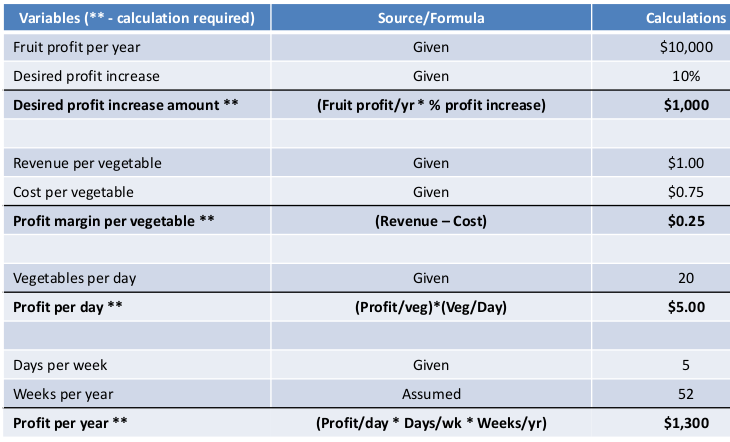
* By talking to customers, your uncle has estimated a potential demand of 20 vegetables per day.
* He expects to sell each vegetable for $1
* Cross-selling to certain customers is expected to generate an additional 5% in revenues
Costs:
* The annual cost of his permit to operate the fruit cart is $1000
* If he sells vegetables, the permit costs will increase by 20%
* The cost of each vegetable is 75 cents
* Cannibalization will decrease fruit sales by 5%
B. Customers
* Your uncle generally serves 3 types of customers: morning commuters, evening commuters, and downtowners on lunch breaks.
* He sees more morning and lunch customers but evening customers tend to buy for home so he sells roughly equal proportions of his fruits to each type of customer.
C. Competition
* There are no competing vegetable vendors nearby.
* Fruit customers generally get their vegetables from supermarkets near their home.
D. Competencies
* You uncle has been in the fruit business for 20 years and his customers appreciate that he knows the peak seasons for the fruits that he sells.
* He is a master at picking out the best fruit for his customers.
* His knowledge in these respects is very limited for vegetables.
3. Qualitative Analysis
A. Profitability:
* Revenues = volume x price
* Costs = variable costs + fixed costs
B. Customers
* similarities/differences to fruit customers
* your uncle’s ability to cross-sell
C. Competition
* Any other vegetable vendors in the area?
* Where are the customers getting their vegetables?
* Are the customers likely to start purchasing their vegetables from uncle?
D. Product
* Your uncle’s expertise with vegetables
* Which vegetables will he offer (veggies for home cooking?)
* Will there be different spoilage rates that make veggies more difficult to keep on hand?
E. Other considerations
* Cannibalization
* Cross-selling
F. Resources
* Where will your uncle get the financing to expand?
* Is there space in his cart to expand?
4. Quantitative Analysis
A. Basic profit calculation
B. Additional profit considerations
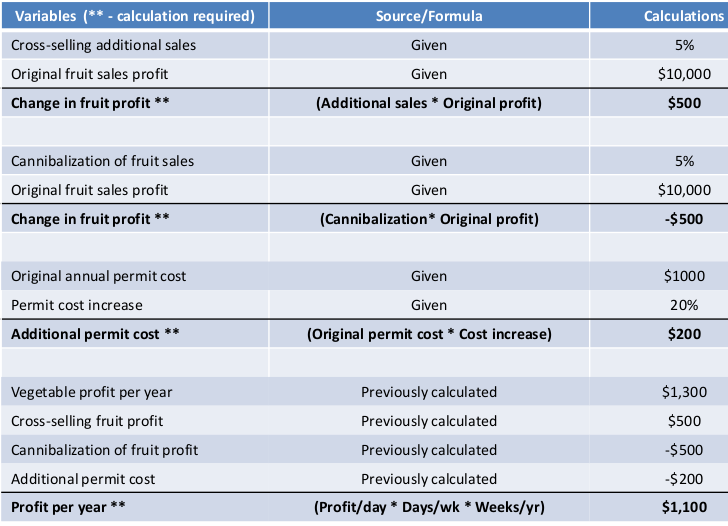
Key Takeaway: Calculated profit $1,100 > Desired profit increase of $1,000
5. Case Closing
A. Recommendation
* At current estimated demand levels, your uncle would be able to surpass his projected profit target of $1,000 by $100 next year. He may want to do informal surveys of his customers to determine which vegetables would be more preferable, which could increase daily demand.
B. Potential Risks
* Since your uncle will just make his target by $100, he must be confident that his lack of expertise with vegetables will not affect his relationships with his customers.
* He must also be aware that his lack of expertise may lead to spoilage rates that could eat into his profits to a degree that he did not anticipate.
* It is also important that he is comfortable that he can find the additional cash (at least $200 to finance the additional permit costs for carrying vegetables).