American Electric Power to Close Underperforming Plants
Case Type: improve profitability; finance & economics.
Consulting Firm: Cornerstone Research first round full time job interview.
Industry Coverage: energy industry.
Case Interview Question #01255: Your client AEP, or American Electric Power (NYSE: AEP), is a major American energy generation company that operates a portfolio of power plants across the Midwest. AEP ranks among the Midwest region’s largest generators of electricity, owning nearly 300 megawatts of generating 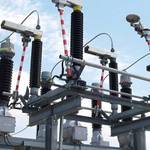 capacity in the Midwest. The company delivers electricity to more than 1 million customers in the Midwest.
In recent years, the client AEP has seen profits stagnate and is concerned about the long-term profitability of their operations. They’ve hired our consulting firm to determine the cause of this stagnation in profits as well as to devise a strategy to improve the company’s overall performance. How would you go about this case?
Possible Answers:
1. Case Overview
Although this case seems like a standard profitability case, candidates may fall into the trap of trying to improve the profitability of the individual power plants. As the interviewer, you will want to direct them to focus on the portfolio of power plants as a whole to recognize that the best strategy to improving profits is selling the under-performing power plants.
In addition, when looking at the cost curve, many candidates will struggle to understand the economics of the industry. Since it is a commodity market with constrained capacity, the market price will be equal to the cost of the first company to not produce any electricity.
2. Information Gathering
Additional Information: only give to candidates if requested
* There are a large number of competitors in the energy generation industry and no single company has a large market share.
* Due to the high capital costs of opening a new power plant, there have been no new entrants over the last decade and it remains unlikely that any new companies will try and enter in the upcoming years.
* Our client AEP (and all competitors) generate the electricity and sell it to the power grid, which is run by a separate company.
* The power grid sees the electricity generated by each company as being exactly equal, so all companies will receive the same price and the power grid will purchase electricity purely based on price.
* Differences in costs between power plants are a combination of generation method and geographic location — lower cost methods are capacity constrained, so costs rise as a greater amount of energy is needed.
* Each power plant has $550 in fixed costs in addition to the variable cost of generation listed on the Exhibit 1 graph.
* Assume that it’s not possible to change the cost of generating electricity at a particular power plant — nor to change the capacity of an individual power plant.
* Demand for electricity is equal to 1,100 MWh (Megawatt hours)
* Assume that if a power plant is closed, its generating capacity is removed from the market permanently.
EXHIBIT 1. Cost Curve for All Installed Capacity: cost of energy generated ($/MWH)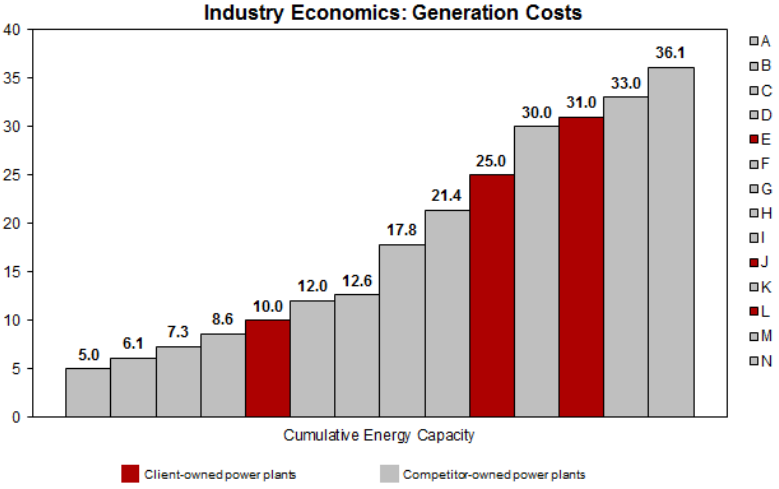
Note: each power plant represent 100 MWH of generation capacity
3. Detailed Analysis
Once the candidates get to the idea of reducing costs at the corporate level, not at the level of an individual power plant, give them Exhibit 1.
Fron Exhibit 1, the candidates should recognize that the client AEP operates a mix of high and low cost power plants, leaning slightly towards the more expensive. Ask them how they would determine the market price. They may try to solve for the market price without asking for the level of demand. If they do so, remind them that the price of electricity (a commodity) is determined by both supply and demand.
They may make the mistake of assuming that the lowest cost producer will take the entire market. This arises if they do not properly read the note at the bottom of the Exhibit that shows how all the power plants are capacity constrained and can produce 100MWh at most.
The next most common mistake is that they’ll assume the price of electricity is equal to the cost of the highest-cost producer who does generate electricity. Lead them through the following thought exercise:
(1) Suppose the price of electricity is currently $30 (equal to cost of highest active producer)
(2) Now suppose that every power generating plant raised their prices by $0.50. Would there be any new competition at this higher price?
(3) They should see that no competitor who was not previously producing will come into the market.
(4) They should then conclude from this that the maximum price without attracting new entrants is $31 (or $30.99).
From this, they should calculate the profitability of each power plant as well as the client company as a whole.
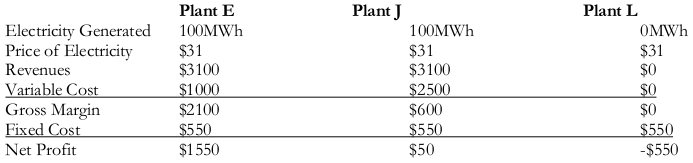
For a total net profit of $1,050 for the firm.
The first thing that they should suggest as a way of improving the firm would be closing down Plant L. Once they do this, ask them to recalculate the firm’s profitability assuming that the Plant is closed. The incorrect answer is to say that the profits of the firm rise to $1,600, just by removing the fixed costs. The insight is that with that capacity removed, the market price will rise to the cost of the next highest-cost producer, which is Plant M for a market price of $33.
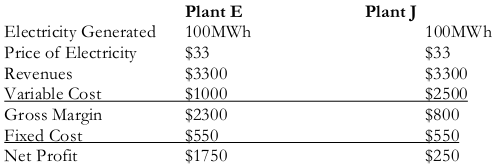
For a total net profit of $2,000.
Next ask them if they have any other ideas for raising net profits. Let them talk through whatever ideas they have, then suggest that they could also close Plant J (since this will again push up prices by reducing the total capacity of the industry). After doing this, prices will rise to $36.1 per MWh
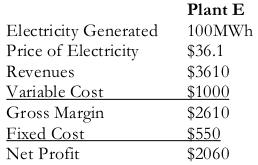
Since the overall increase in profits (from $2,000 to $2,060) is relatively small, ask them to discuss the benefits vs. costs of closing Plant J. Costs should focus on the risks of having all generating capacity in one power plant. Once they’ve done this, say the following:
“Suppose that we expect 200MWh of wind generating capacity to come online in the next 5 years. In the long run, what will this do to the industry and energy prices?”
Since you specified that it was in the long run, the candidate should recognize that the cost of generation for wind is effectively zero (ignoring installation costs), so this will add 200MWh to the lowest end of the market, pushing prices down to $30/MWh (which would make Plant J unprofitable if not already closed).
After this, ask them to conclude.
4. Conclusion & Recommendation
* The client AEP should close Plant L as this will nearly double profitability in the short term by eliminating the fixed costs of that plant.
* They should also consider closing Plant J as the boost to prices by restricting supply is greater than the lost profits from the plant.
* In the long term, the company should invest in lower-cost production methods and renewable energy to prepare for the introduction of wind generation capacity.