Potash Corp to Build In-House Distribution Channel
Case Type: improve profitability.
Consulting Firm: L.E.K. Consulting first round full time job interview.
Industry Coverage: chemical industry.
Case Interview Question #01254: Your client The Potash Corporation of Saskatchewan (TSX: POT, NYSE: POT), also known as PotashCorp, is a Canadian corporation based in Saskatoon, Saskatchewan which mines potash, phosphate, nitrogen and other fertilizer products. As of 2014, the company is the world’s largest potash  producer and the third largest producer of nitrogen and phosphate, three primary crop nutrients used to produce fertilizer.
In the past year (FY 2013), our client Potash Corp.’s sales volumes have hit an all-time high. However, their profits have slipped in the most recent quarter (Q4 of FY 2013). What happened and how will you help the client fix their problem?
Possible Answers:
1. Case Overview
The case is essentially a practice of the basic profitability framework:
profits = revenues – costs = (price x volume) – (variable cost + fixed cost).
Since the candidate is told that sales volumes are at an all-time high, the profit decline must either be from prices or costs. Once told that no costs have increased, they should see that prices must be the problem.
The key insight is that while no individual prices have changed, the product mix changed towards lower price products. From this, the candidate should look at the substantial drop in the highest margin products. They should notice that production has increased of the lower cost version, yet margins haven’t increased, leading the candidate to the final conclusion that the lower price is hurting sales.
2. Information Gathering
Additional Information: only give to candidates if requested
* The client The Potash Corporation of Saskatchewan is the largest producer of fertilizer products in Canada.
* The fertilizer industry is highly fragmented, no competitor large enough to have affected our sales.
* Prices and costs of individual products are unchanged.
* Gross margins: Potash: $250/tonne, Nitrogen: $150/tonne and Phosphate:$100/tonne
* The client company recently began switching to offshore potash (vs. North American potash) as it can be produced more cheaply.
* Offshore potash is projected to grow 50% from 2012 to 2013.
* Industry standard for potash is to have the customer pay their own freight with whomever they wish to have transport the product.
* Due to higher freight costs customers face, our sale price of offshore potash is heavily discounted versus North American potash.
EXHIBIT 1. Sales Mix for Potash Corp. (% of tonnes sold)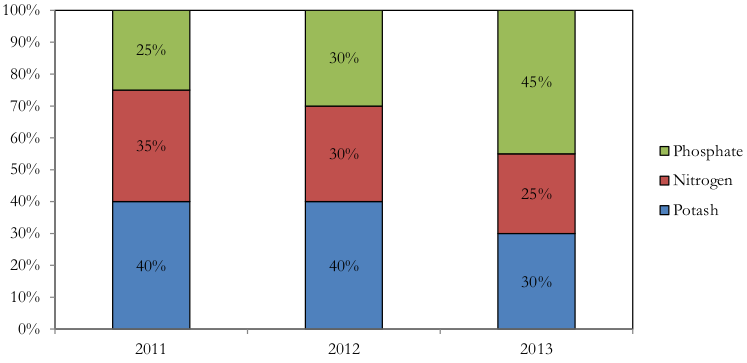
EXHIBIT 2. Sales Volumes of Potash (000s of tonnes)
*Total sales volumes for FY 2012 and FY 2013 for all products combined are the same.
3. Detailed Analysis
First, from Exhibit 1 the candidate should notice that phosphate has become a much larger portion of sales volumes and potash has recently declined. This should prompt them to ask about the margins on each product line, which will prompt being given the gross margin data.
Have the candidate find the effect of the change from 2012 to 2013 on margins.
* In FY 2012: 40% at $250 margin + 30% at $150 margin + 30% at $100 margin = Average $175/tonne
* In FY 2013: 30% at $250 margin + 25% at $150 margin + 45% at $100 margin = Average $157.5/tonne
* $157.5/$175 = 0.9 = 90% –> Decrease of 10% for average price.
When the candidate asks about changes in the potash market that would have caused the sales decline, give them Exhibit 2. From Exhibit 2, they should solve for the 2013 figures (if they do not automatically do so, prompt them to.)
In 2013, offshore potash will grow by 50%, thus there will be 1,800,000 * 150% = 2,700,000 tonnes sold in 2013. Next, since overall sales volumes across all product lines are the same, the two years potash sales are 40% and 30% of the same total. Thus, combined potash sales (North American Potash + Offshore Potash) in 2013 must be 3/4 of 2012, which means total potash sales in FY 2013 are 6,000,000 * 3/4 = 4,500,000 tonnes, of which 2,700,000 tonnes are offshore potash and 1,800,000 tonnes are North American potash.
Finally, once the candidate suggests eliminating the freight discount and moving distribution inhouse, have them do the following calculation:
Assume the freight discount on offshore potash is $80 per tonne and if eliminated, sales volumes of offshore potash will return to their 2012 levels. If freight costs will be $50 variable per tonne and the rest is a fixed depreciation charge on an investment depreciated over 10 years, what is the most we would be willing to invest?
Since we earn $80 more per tonne and incur $50 variable cost per tonne, we would be willing to incur as much as a $30 depreciation charge per tonne. At 1,800,000 tonnes, the annual depreciation charge can be as much as 1.8M * $30 = $54 million. Since the investment is depreciated over 10 years, we should invest no more than $540 million.
An astute candidate may make mention that we might be willing to pay more if this also leads to an increase in North American potash revenues — ignore for purposes of calculations.
4. Conclusion & Recommendation
* The major cause of the decline in profits is due to a movement away from high margin potash, towards lower margin products, such as phosphate. In total, this switch costs us 10% of our gross margins.
* The decline in potash sales is because sales of lower priced offshore potash are cannibalizing sales of the higher priced North American potash due to the freight discount.
* If we were to eliminate this discount, we could profitably invest as much as $540 million to build the distribution channel needed to bring freight in-house, justifying the higher price.