America First Credit Union to Attract Wealthy Customers
Case Type: improve profitability.
Consulting Firm: American Express first round full time job interview.
Industry Coverage: financial services.
Case Interview Question #01244: Your client America First Credit Union (AFCU) is a federally chartered credit union headquartered in Riverdale, Utah. As of Jan 2017 the client America First has 120 branch locations, and has over USD $8.22 billion in assets. AFCU is the 8th largest credit union in the  United States in terms of total membership and 12th largest credit union in terms of assets.
In the previous year, the client AFCU earned $8 billion in revenues and $500M in profits, which was an increase of 3% over the year before. Recently however, they have noticed that their profitability is significantly lower than other credit unions that operate similar numbers of branches in other regions. The client has hired our consulting team to identify the causes of the discrepancy in profits as well as ways to solve it. How would you go about this case?
Possible Answers:
1. Case Overview
Although the underlying structure of this case is a profitability calculation, the challenge in the case comes from needing to understand the credit union business on a deeper level than usual in order to identify the correct solutions. In order to get this understanding, the candidates should ask about the credit union business in the U.S. and how it makes money, so that they have more grounding when they start looking at the drivers of profitability. In addition, the candidate should look at what competitors are doing so that they can identify why the client is less profitable.
2. Information Gathering
Additional Information: only give to candidates if requested
* A credit union is a member-owned financial cooperative, democratically controlled by its members, and operated for the purpose of promoting thrift, providing credit at competitive rates, and providing other financial services to its members.
* The overall financial services industry can be divided up into three areas: insurance, banking and payments — credit unions are only licensed to operate in banking and payments in the United States.
* Credit unions typically operate in a limited geographical region and offer a more community-focused banking experience than the national banks (which are much larger and thus can offer a greater variety of services); another major difference between national banks and credit unions is that the branches of a credit union are all semi-independent and run by their local owners, whereas a bank has full control over the actions of any of their branches.
* The typical customer of a credit union is older and less wealthy than the typical client of a bank; they are also very likely to have grown up in the same region as they currently live.
* When customers were polled about the most important reason why they chose their current bank or credit union:
– 27% said they grew up with that bank,
– 22% said availability of products,
– 18% said fees and/or interest rates offered,
– 15% said customer service and bank culture,
– 12% said availability of ATMs and bank branches,
– 6% said variety of products available.
* The banking sector makes money by making loans at a higher interest rate than their source of funding; the sector is growing at a rate of 2% annually and profit margins average 8%.
* The payments sector makes money from fees by facilitating payments and transfers, either through debit and credit cards or money transfer services; the sector is growing at a rate of 5% annually and profit margins average 10%.
* Our client AFCU’s banking division manages 3M client accounts, which earns a total of $6B in revenues and earns $300M in profits; the client AFCU’s payments division processes 2B transactions per year, earning $2B in revenues and $200M in profits.
* We know that similarly-sized competitors earn $2,000 per client account in banking and $1.50 per transaction in payments.
* Any loans not funded by deposits need to be funded through short-term debt, which costs significantly more than deposit funding.
* Any deposits in excess of available loans earn a very low interest rate.
3. Detailed Analysis
When the candidate gets to the information comparing the client AFCU’s performance to that of other similarly-sized credit unions, they should look at both the relative revenue generation and profitability of both business segments (banking immediately below, payments halfway down page)
a. Banking
For the banking division, the client AFCU earns $2,000/account ($6B divided by 3M client accounts) and a profit margin of 5% ($300M / $6B). Thus the banking revenues are equal to the industry average, but the company has lower margins than industry average of 8%, which imply that their costs are higher than competitors.
Once the candidates get this conclusion, ask them to think of what some of the major costs for the retail banking operation would be. The answer you are looking for is their funding costs (the cost of the money they loan out). If the candidate has a weaker knowledge of banking, they may need some help to get this answer, but once they do, give them Exhibit 1.
Exhibit 1. Asset Funding for Independent Member Firms: Liability Structure of Branch Networks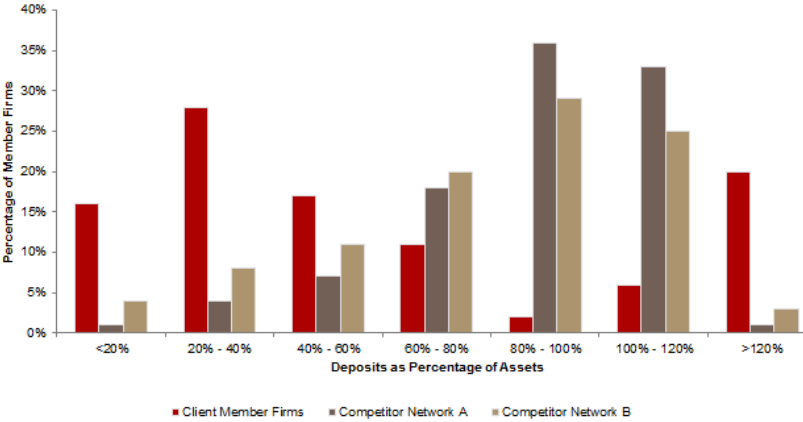
The insight from this graph is that the client AFCU’s deposits do not match up well with their loans (remind the candidate if necessary that deposits are a source of funding — and thus a liability, while loans made are an asset of the bank), so some branches are forced to fund loans with high-cost short-term debt, while other banks have deposits going to waste since they don’t have enough loans.
To resolve this problem, the candidate should suggest at least two solutions:
* The first is to increase the amount of deposits at the underfunded branches. To do this, the candidate should draw on the customer profile to better market to them.
* The second is to move deposits between banks to even them out. If the candidate just suggests moving them, remind them that credit union branches are independent and ask how they could incentivize overfunded branches to give underfunded branches their deposits. The answer is that they could borrow the deposits and pay some interest rate higher than what unused deposits earn, but lower than the interest rate on short-term debt.
b. Payments
For the payments division, the client AFCU earn $1/transaction with a profit margin of 10% ($200M/$2B), so they are earning lower revenues than the industry average of $1.50 per transaction, although their profit margins are on par with the standard. Once they recognize this, give them Exhibit 2.
Exhibit 2. Payments Service Use Breakdown by Customer Wealth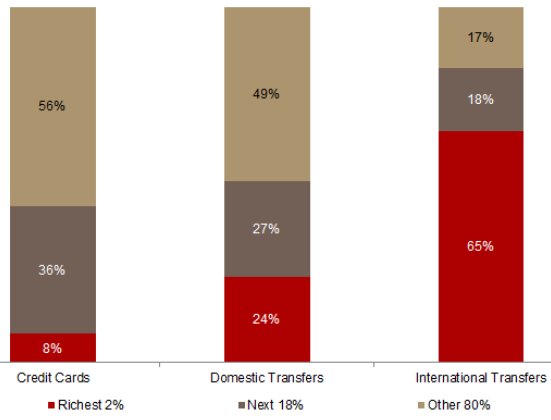
Note: Average credit card revenue per transaction is $0.50; average domestic transfer revenue per transaction is $1.50; and average international transfer revenue per transaction if $5.00
From this graph, the candidates should recognize that the richest customers disproportionately use the more expensive services. They should also remember that credit union customers are typically less wealthy than the average bank customer.
If they ask, tell them that 0.25% of the client AFCU’s customers are in the richest 2%, 9.75% are in the next richest 18% and the remaining 90% are in the poorest 80%.
To solve the revenue issue, the candidate should suggest attracting more wealthy clients and then prompt them to think of a strategy to do so.
4. Conclusion & Recommendation
There were two main issues holding back our client AFCU’s profitability: high funding costs in the banking division and low revenue per transaction in the payments division.
* To reduce funding costs, we should allow credit union branches to lend more easily to each to reduce both unused deposits and reliance on short-term debt.
* In the payments division, we need to attract wealthy customers who use the most expensive services. One way to do this will be to partner with credit unions in other regions to offer our services across the entire country.