Family Dollar Stores to Pursue Cost-based Pricing Strategy
Case Type: improve profitability; pricing strategy.
Consulting Firm: OC&C Strategy Consultants 2nd round full time job interview.
Industry Coverage: retail.
Case Interview Question #01242: Your client Family Dollar Stores Inc. is a chain of dollar stores across the United States. A dollar store, also known as variety store, is a retail store that sells a wide range of inexpensive household goods including food and drink, personal hygiene products, small home and garden tools,  office supplies, decorations, electronics, garden plants, toys, pet supplies, remaindered books, recorded media, and motor and bike consumables.
Although the overall dollar store business has boomed as a result of the recent economic recession in the United States, as customers have shifted away from big box retailers to cheaper alternatives, the client Family Dollar Stores has found that profit growth has not done as well as revenue growth. Since revenue growth has started to slow, improving profitability has become a key priority for the client and they have hired our consulting firm to investigate the issue. How would you go about helping the client to improve their profitability?
Possible Answers:
1. Case Overview
This case is a relatively simple profitability case. In fact, since the candidate is told that revenue growth has been strong in the past, they should automatically recognize that costs are more likely to be the issue in the case. Therefore, the candidate should move fairly quickly through the main portion of this case and onto the calculations. Since the core case portion is fairly easy, the calculations are more detailed, making this case good for practicing case math.
2. Information Gathering
Additional Information: only give to candidates if requested
* Overall retail sales growth has been 0.5% in the United States, with the discount store subsection growing at 4%; our client Family Dollar Stores has grown at a CAGR of 5.5% over the past five years.
* Although revenues have grown by 5.5% per annum, profits have only grown at a 1% CAGR, compared to 3% for the discount store subsection as a whole.
* Historically, the main customer group for discount stores were poor households, particularly those on government assistance. For this reason, most stores accept government food stamps as a method of payment. However, over the last 4 years, the major source of growth for the category has been lower middle class households shifting their purchases towards cheaper alternatives like dollar stores.
* Our client Family Dollar Stores competes directly with three other major dollar stores chains in the United States (Dollar Tree, Dollar General, 99 Cents Only Stores) and is the smallest of the four companies (by revenue and by number of stores); it also competes indirectly with other big box discount stores, like Walmart.
* Within the dollar store segment, there are two main pricing strategies: offer every item in store at $1 and offer a more limited selection of items, or offer items at prices ranging from $1 – $5 and restrict size and quality of products so that they can be offered within this price range, allowing for a greater variety of products.
* Of the four dollar store chains: Dollar Tree, Dollar General, 99 Cents Only Stores, and Family Dollar Stores, two (including our client) use the all $1 strategy, and two of the competitors use the broader low-price strategy.
* The largest area of cost for the client is COGS, which represents ~80% of sales on average, although this differs from product to product.
* The top 5 SKUs make up 80% of the client’s revenues and effectively all of its profits, once overhead is allocated by product line.
3. Detailed Analysis
Once the candidate starts asking about the specific profitability of the different SKUs, give them Exhibit 1.
EXHIBIT 1. Variable Cost and Sales Volume Review of Top 5 SKUs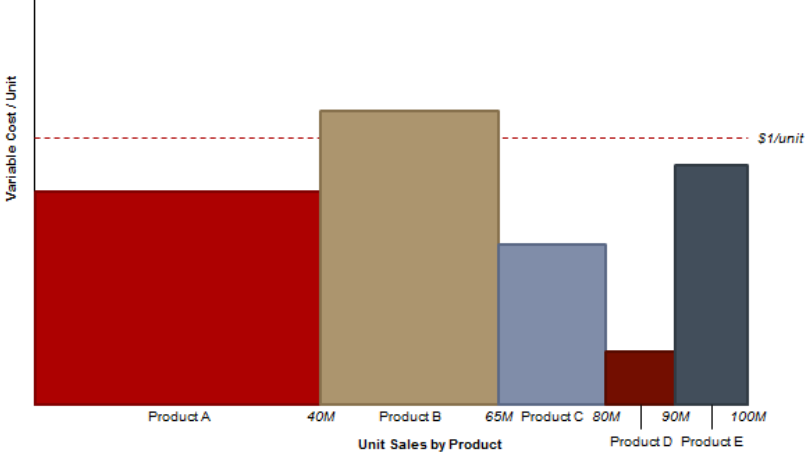
From Exhibit 1, the candidate should immediately recognize that one of the largest issues is that Product B is unprofitable because its variable cost is greater than $1. They may also note that Product D is extremely profitable because its variable cost is negligible. Give them the following cost figures and ask them to calculate gross profits by product.
* Product A costs $0.80 per unit
* Product B costs $1.10 per unit
* Product C costs $0.60 per unit
* Product D costs $0.20 per unit
* Product E costs $0.90 per unit
Profit calculations are shown below:
| SKU | Product A | Product B | Product C | Product D | Product E |
| Unit sales | 40M | 25M | 15M | 10M | 10M |
| Revenue/unit | $1.00 | $1.00 | $1.00 | $1.00 | $1.00 |
| Cost/unit | $0.80 | $1.10 | $0.60 | $0.20 | $0.90 |
| Profit/unit | $0.20 | $-0.10 | $0.40 | $0.80 | $0.10 |
| Net profits | $8M | $-2.5M | $6M | $8M | $1M |
With total profits equal to $8M – $2.5M + $6M + $8M + $1M = $20.5M.
After getting this calculation, tell the candidate that the client Family Dollar Stores has been considering a number of pricing strategies to improve profits and want us to identify which will improve profits the most.
Tell the candidate: “The first pricing strategy is moving away from pricing everything at $1 and instead have a variety of prices to reflect costs. Under this strategy, the prices of Products A, B, and E will be raised to $1.50 and the price of Product D will be lowered to $0.50. Unit sales of Product A are expected to fall by 25%, B by 20% and E by 10%; unit sales of Product D are expected to rise by 50%.”
The candidate should then proceed to calculate the new unit sales and profits, as shown below:

With total profits equal to $21+$5+$6+$4.5+$5.4 = $41.9M (more than double base profits of $20.5M).
Now tell the candidate: “The other idea was to cut the least profitable products out, with the hope that customers would shift their spending towards the more profitable units. Under this strategy, Products B and E would be eliminated, leading to a 50% increase in sales of Product A, 40% increase in sales of C and doubling in sales of D.”
Again, they should calculate profits as shown below:

With total profits equal to $12+$8.4+$16 = $36.4M (80% higher than the base profits of $20.5M).
After this, the candidate may ask if it would be possible to engage in both strategies simultaneously (or some combination of partially using both). Tell them it’s a good idea, but not something the client wants to pursue immediately. Once the candidate has discussed the results from the calculations, ask them to conclude the case.
4. Conclusion & Recommendation
* We identified that the major constraint on profits is that prices for products are not aligned with their cost of goods sold, including some products that are sold below cost.
* The best strategy is to move towards a cost-based pricing strategy, raising the price of the most expensive products and lowering the price of the cheapest products, which will raise profits by more than 100%.
* In the future, the client company should look for product categories that it can enter for its new middle-class shoppers, that can be provided cheaply to match the existing price level.