Wells Fargo Bank Uses Big Data to Increase Loan Recoveries
Case Type: improve profitability; new technology.
Consulting Firm: Capital One first round full time job interview.
Industry Coverage: banking; software, information technology (IT).
Case Interview Question #01240: Big data is data sets that are so voluminous and complex that traditional data processing application software are inadequate to deal with them. Lately, the term “big data” tends to refer to the use of predictive analytics, user behavior analytics, or certain other advanced data analytics  methods that extract value from data. Analysis of data sets can find new correlations to spot business trends.
Your client Wells Fargo Bank (NYSE: WFC) is a major bank offering a full range of financial services in the United States. Headquartered in San Francisco, California, and with “hubquarters” throughout the country, Wells Fargo is the third largest bank in the U.S. by assets. Recently, the CEO of Wells Fargo Bank has been hearing a lot about “Big Data” and the value of it to businesses. He wants you to help him better understand this trend and provide some steps to begin this using “big data” technology to drive profits for his bank. How would you go about it?
Possible Answers:
1. Case Overview
There are three distinct portions of this case, each testing a different skill of the candidate.
First, the candidate should think broadly about what services a big bank offers and the relative value of data to each. Prompt the interviewer to approximate each segment’s percentages of the market with logical reason to support their figures and then have them calculate the dollar value of each segment using the correct data.
Next, within the retail banking sector, a stellar candidate will use a profit tree or similar structure to identify all areas where data can increase profits.
Finally, the last section tests the candidate’s quantitative skills and reasoning to determine the optimal strategy for collecting overdue debts.
Note to Interviewer: Give the candidates the exhibits and guide them through (if necessary) the calculation shown on under “Detailed Analysis”
2. Information Gathering
Additional Information: only give to candidates if requested
* Overall market for “Big Data” in finance: USD $175 billion
– Insurance — 15% (approximately $26B)
– Retail banking — 35% ($175B * 35% = approximately $62B)
– Commercial banking — 20% (approximately $35B)
– Capital markets — 30% (approximately $53B)
3. Suggested Structure
Profits = Revenues – Costs = (Volume * Price) – (Fixed Costs + Variable Costs)
To increase profits:
* Drive volume through measures such as: cross-selling, more precise segmentation, individualized marketing, etc.
* Raise revenue per customer by: more accurate tracking of account usage, more convenient billing process, increasing diversity of product offering, etc.
* Cut costs by: eliminating unnecessary/unused services, reducing and automating routine paperwork, reducing needed amount of physical branches, raise use of bank/credit cards versus cash, reduce delinquency costs on loans (defaults on debts)
This is not an exhaustive list, a strong candidate will identify opportunities not listed above. If they miss a category, tell them to look at all areas of profits. Guide them until they get delinquency costs, then give them the Exhibits.
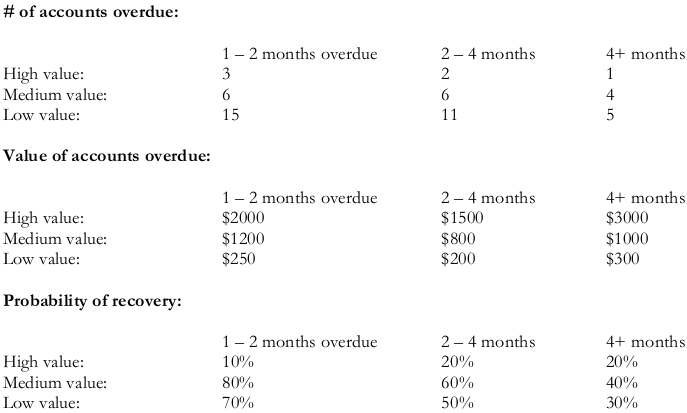
4. Detailed Analysis
* The client Wells Fargo Bank currently pursues overdue accounts by date (farthest overdue first)
* An average loan officer will have a book of overdue accounts as listed below and can pursue at most 10 accounts in one time period.
From the Exhibit, Expected recovery = Value of account * Probability of recovery
| Account type | 1 — 2 months overdue | 2 — 4 months | 4+ months |
| High value: | $2,000*10% = $200 | $1,500*20% = $300 | $3,000*20% = $600 |
| Medium value: | $1,200*80% = $960 | $800*60% = $480 | $1,000*40% = $400 |
| Low value: | $250*70% = $175 | $200*50% = $100 | $300*30% = $90 |
Currently the loan officer pursues the ten most overdue accounts, since there are on average 10 that are over four months overdue, they pursue those ten. The candidate should suggest pursuing most valuable accounts first — the bolded numbers shown above. Note that since they can only pursue ten accounts at a time, they can only pursue 3 of the $480 recoveries, not all 6.
* Current expected recovery: 1 * $600 + 4 * $400 + 5 * $90 = $2,650
* If they prioritized the highest value recoveries: 6 * $960 + 1 * $600 + 3 * $480 = $7,800
* This is an increase of $7,800 – $2,650 = $5,150 per loan officer, or $5,150/$2,650 = 194% ~= 200%
5. Conclusion & Recommendation
* “Big Data” offers billions of dollars in value to financial services firms, including over $60 billion to retail banking divisions.
* Data can be used both to increase revenues through better targeting of services as well as eliminating multiple types of costs.
* In particular, the client Wells Fargo Bank can increase its loan recoveries by 200% ($5,150 per loan officer) by using customer data to identify the highest expected recovery accounts.