76 Gas Stations to Improve Convenience Store Revenues
Case Type: improve profitability; increase sales/revenues.
Consulting Firm: Analysis Group 2nd round full time job interview.
Industry Coverage: oil, gas, petroleum industry; retail.
Case Interview Question #01239: Our client 76 (formerly Union 76) is a chain of gas stations and convenience stores located within the United States. The name “76″ referred to the 1776 United States Declaration of Independence, and was also the octane rating of the gasoline in 1932. As of May 1, 2012, 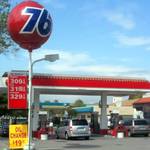 the “76″ brand is owned by Houston, Texas-based multinational energy corporation the Phillips 66 Company (NYSE: PSX).
The “76″ chain has gas stations all over the United States. Over the past year or so (2011-2012), they have noticed a decline in profits. What factors may be contributing to this and what can they do to alleviate the situation?
Possible Answers:
1. Information Gathering
Additional Information: (to be provided to candidates upon request)
* The client 76′s business has 2 segments: gas/filling station and convenience store.
– Gas station segment traditionally has lower profit margin
– Convenience store traditionally has higher profit margin
* Some customers shop at the gas stations only. Some shop at the convenience stores only and some go to both on the same trip.
* The number of our client’s gas stations/convenience stores has remained constant in the past 3 years.
* Our client 76′s gas stations revenues are within industry average, but prices of items in their convenience stores are higher than those of major competitors.
* Exhibit 1: U.S.A. average gas and oil prices, 2008-2013
* Exhibit 2: Breakdown of sales and costs by business segment
* Exhibit 3: Consumer demand by segment
Exhibit 1: U.S.A. average gas and oil prices, 2008-2013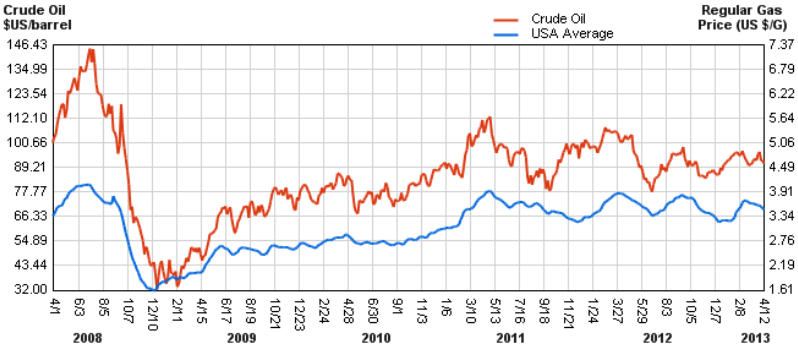
Exhibit 2: Breakdown of sales and costs by business segment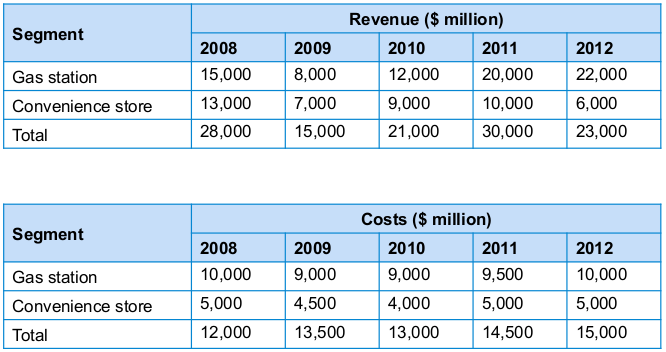
Exhibit 3: Consumer demand by segment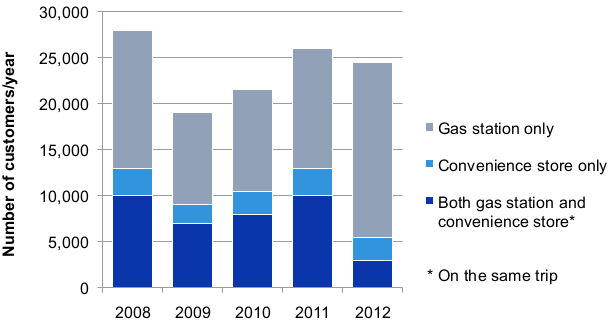
2. Sample Structure (any reasonable one is acceptable)
Profit = Revenue – Cost = (Number of units sold * Price/unit) – (Fixed cost + Variable cost)
Variable Cost = Cost/unit * Number of units sold
3. Detailed Analysis
Interviewer note: ask the following questions sequentially and provide Exhibits when prompted.
Question #1. What factors may be contributing to the client’s decrease in profit?
Possible Answer:
This is a brainstorming question; possible answers include but are not limited to the following:
* Gas station segment:
– Improvement in public transportation
– New legislation to limit number of vehicles
– Oil prices have increased, leading to a drop in demand
* Convenience store segment:
– Increased competition from large grocery stores/supermarket chains, e.g. Wal-Mart.
– Decline in quality of goods sold.
– Increases in COGS, rent, labor, etc.
Question #2. What do you think is responsible for the client’s decrease in profit from year 2011 to 2012?
Possible Answer:
A good candidate should have touched on oil prices and revenue streams/costs from Question #1. Then, provide Exhibits 1 and 2. The candidate should make the following observations:
* From Exhibit 1:
– Oil prices dropped suddenly at the end of 2008 but steadily went back up and have stayed fairly constant from 2011-2012. So this is likely not the major contributor.
* From Exhibit 2:
– In fact, the gas station segment saw a profit increase of $1.5 billion.
– However, the convenience store segment saw a profit decrease of $4 billion: $4 billion drop in revenues, no change in costs.
– So overall, there is a net profit decrease of $2.5 billion.
Conclusion: The major driver for the client’s profit decline from 2011-2012 was the drop in revenue in the convenience stores.
Question #3. What do you think has caused the sharp drop in revenue in the convenience stores?
Possible Answer:
A strong candidate should come up with possible reasons why convenience stores are seeing a sharp drop in revenue. A list of reasons include, but are not limited to the following.
* This could be due to either or both of the following:
– The overall number of customers is decreasing.
– Change in the distribution of customers.
Question #4. Now provide Exhibit 3. What can be concluded from Exhibit 3?
Possible Answer:
The candidate should make the following observations:
* Total number of customers dropped only slightly.
* The number of customers that go to convenience stores only remained roughly the same.
* There was a shift from the “both” segment to the “gas station only” segment.
– This led to a loss in revenue in the convenience stores.
Question #5. What can our client “76″ do to increase their profitability?
Possible Answer:
* Conduct customer survey to figure out if needs are being met and areas for improvement.
* Lower prices in the convenience stores.
* Promote synergy between gas station and convenience store segments.
– Introduce customer loyalty program.
– Give convenience store coupons every N gas fills.
– Give gas points for purchases over a certain amount at the convenience store.
4. Conclusion & Recommendation
Question #6. Ask the candidate to summarize his/her findings and make a final recommendation to the client.
Possible Answer:
I recommend that the client “76″ focuses on improving the revenue at their convenience stores in order to increase profitability. My analysis indicated that the profit decrease from 2011-2012 was due mainly to a drop in the number of customers who visited both the gas station and convenience store segments on the same trip.
Our client “76″ can try to alleviate the situation by promoting more synergy between the two segments, for example, by offering convenience store coupons for a fixed number of gas fills, or giving gas points for purchases over a certain amount at the convenience store.
However, it is possible that these measures do not solve the client’s problem entirely, and so in terms of next steps, we recommend that the problem is investigated further to identify what caused the shift away from the convenience stores in the first place.