Cisco Systems to Focus on Most Profitable Product
Case Type: improve profitability; math problem.
Consulting Firm: IBM Global Business Services (GBS) first round full time job interview.
Industry Coverage: telecommunications & network.
Case Interview Question #01181: Your client Cisco Systems, Inc. (NASDAQ: CSCO) is an American technology company headquartered in San Jose, California. The company develops, manufactures, and sells super high speed networking hardware, telecommunications equipment, and other high technology  services and products.
In 2009, Cisco Systems developed a milestone technology that could eliminate 99% of the disconnection issues in traditional devices. This new technology has helped the company become a monopoly in the industry. Last month, Cisco Systems welcomed its new CEO, John Chambers, who is known to be the most aggressive leader in Silicon Valley. John is not satisfied with his company’s current profitability level and wants you to help them on this issue.
Possible Answers:
1. Additional Information
* This is mainly a profitability case. The CEO’s target is to achieve 40% on gross profit margin.
* There is no information about previous profit margin. Just tell the candidate to focus on current product.
* Ignore the competition in the whole industry.
* A good candidate should provide a framework to include both increasing revenue and reducing cost.
* Guide the candidate to start from the cost side.
2. Detailed Analysis
Prompt #2: The client Cisco Systems has three products: Product A, B and C. They only differ from one another slightly. All three types share the same, and only production line. The client doesn’t want to increase internal capacity or expand by merger and acquisition.
The client has decided to focus on just one product in the future as manufacturing three together significantly impacts operational efficiency. Start from cost side and provide candidate with Exhibit #1.
Exhibit #1: Costs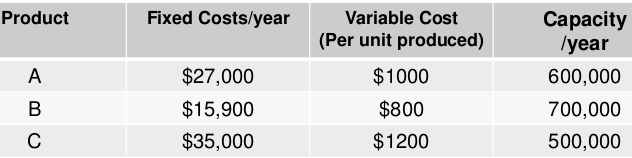
Possible Answer:
From prompt #2, the candidate should understand that the ultimate goal is to select the one product which could result in the highest profit margin, and compare this to the 40% goal.
Note: The information provided by Exhibit #1 is not adequate for the candidate to make decision since no information about volume and price is given at this moment.
* Exhibit #2 can be provided together with Exhibit #1 if the candidate asks about capacity and market demand.
* Do not provide Prompt #3 and Exhibit #3 at this moment.
Insights from Exhibit #1:
* The candidate should quickly figure out that fixed cost is negligible.
* A good candidate might ask whether full capacity could be reached for each of them. If asked, give him/her Exhibit #2, otherwise, wait until the candidate finishes calculations here.
Neglect the fixed cost, the operational cost of three products if reaching full capacity.
* Product A: Cost_A = 1,000 * 0.6M = $0.6B
* Product B: Cost_B = 800 * 0.7M = $0.56B
* Product C: Cost_C = 1,200 * 0.5M = $0.6B
Exhibit #2: Annual Market Demand (Unit: Thousands)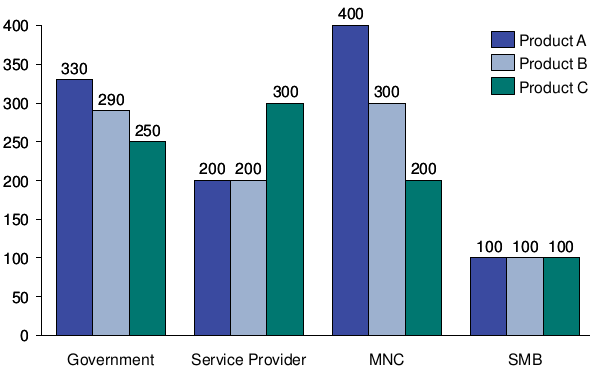
Exhibit #2 shows the four customer segments Cisco Systems sells to.
* MNC represents Multi-national company.
* SMB represents small and medium business.
The candidate should tell from Exhibit #2 that the client Cisco Systems cannot meet the demand for any of the three products. As the client won’t increase capacity at all, they need to operate at full capacity no matter which product they decide to make.
Calculations:
* For product A, the total demand is: 330+200+400+100=1030 > 600
* For product B, the total demand is: 290+200+300+100=890 > 700
* For product C, the total demand is: 250+300+200+100=850 > 500
Prompt #3: The client Cisco Systems sells its product through three different channels — direct sales, distributors and authorized partners. In each segment, the end consumers get the same price for the same product, no matter what channel the product is sold through.
* The fixed cost for direct sales is $100 Million per year. No extra variable cost.
* Provide the candidate with Exhibit #3.
Exhibit #3: Pricing
A. The end customer price in each segment for each product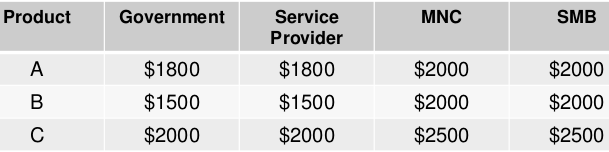
B. The price Cisco Systems sells to resellers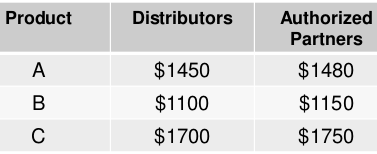
Possible Answer:
* Touch on how and at which price the client sells products – the revenue side.
* Traditionally, an equipment manufacturer sells its product directly or through resellers such as distributors or partners.
* If the product is sold through resellers, the client should not care about end customer price.
Insights from Exhibit #3:
* It’s clear that the client can make more money by selling through partners than distributors.
* If the client sells only through partners, the gross margin cannot reach 40% at all. See calculations below.
* For direct sales, the candidate should use the market price as we do not use agency. The client should sell to MNC and SMB first as their prices are higher than the other two, and then sell to government or service provider.
Calculations:
a. For partner prices:
* Product A: ($1480 – $1000) / $1480 = 32.4%
* Product B: ($1150 – $800) / $1150 = 30.4%
* Product C: ($1750 – $1200) / $1750 = 31.4%
b. For direct sales, the revenue should be
* Product A:
– Total capacity = 600K = 100K SMB + 400K MNC + 100K government or service provider
– Revenue = $2000 * (100+400)K + $1800 * 100K = $1.18B
* Product B:
– Total capacity = 700K = 100K SMB + 300K MNC + 300K government or service provider
– Revenue = $2000 * (100+300)K + $1500 * 300K = $1.25B
* Product C:
– Total capacity = 500K = 100K SMB + 200K MNC + 200K government or service provider
– Revenue = $2500 * (100+200)K + $2000 * 200K = $1.15B
As we already got the operational cost:
Product A: $0.6B
Product B: $0.56B
Product C: $0.6B
Obviously product B has the highest margin:
* Product A: ($1.18B revenue – $0.1B fixed cost for direct sales – $0.6B operational cost)/$1.18B = 0.48/1.18 = 40.7%
* Product B: ($1.25B revenue – $0.1B fixed cost for direct sales – $0.56B operational cost)/$1.25B = 0.59/1.25 = 47.2%
* Product C: ($1.15B revenue – $0.1B fixed cost for direct sales – $0.6B operational cost)/$1.15B = 0.45/1.15 = 39.1%
3. Recommendation
Sample recommendation: From the calculation, we recommend the client manufacture product B and sell only by direct sales.
Note:
* The candidate should reach the recommendation naturally after calculation.
* Bonus Question: If there is more time, the interviewer could guide the candidate on more qualitative analysis. For example, what are the other ways to increase the profit margin?
The suggested answer could include increasing the price to resellers, expanding the production line to achieve better scales of economy, or stimulating sales force to reach to more MNC and SMB customers. This is an entirely open-minded question.
4. Performance Assessment
a. Average Candidate
* Have basic understanding of cost structure.
* Resolve the case by passively receiving each prompt.
b. Good Candidate
* Proactively lead case in both cost and rev branches.
* During framework, naturally come up with concepts such as customer segmentation or sales channel, etc.
* Efficient in calculation.
c. Excellent Candidate
* Not only get to the right answer, but also provide further thoughts to expand the possibilities in achieving the target.