East Village Grocery Store to Stop Issuing Coupons
Case Type: improve profitability.
Consulting Firm: American Express first round full time job interview.
Industry Coverage: small business; retail.
Case Interview Question #01169: The year is 2009. Our client is a mom-and-pop grocery/convenience store that is located in New York City. They have approached us with the following problem: while their sales have almost doubled during the last 6 years (from 2003 to 2008), their profits have been flat. In fact,  profits even declined sharply for last year (2008).
After preliminary investigation, our case team obtained a copy of their sales and profits data for the last 6 years (2003-2008, see Exhibit #1). All numbers are in $ millions. What do you think is the issue here?
Additional Information:
Exhibit #1. Sales and profits data 2003-2008 ($ millions) 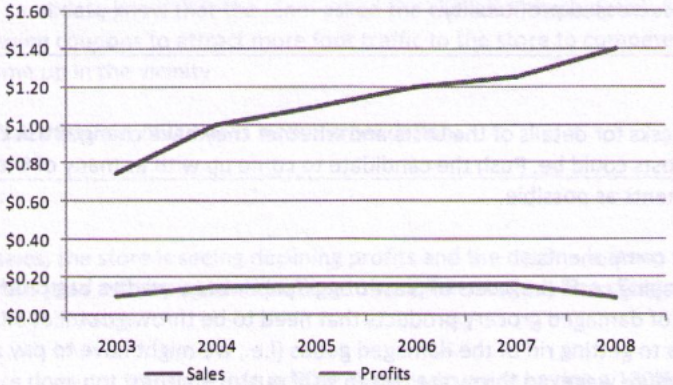
Possible Answers:
At this point the candidate should mention that the issue seems to be that despite a jump in sales, the shop is seeing declining profitability and he/she would like to analyze why that might be the case.
1. Additional Information:
If the candidate asks pointed questions provide the information below when asked. Do not provide any of the information if the candidate does not ask for it. If the candidate asks about whether product mix has changed, challenge the candidate to ask what s/he thinks the product mix of a grocery/convenience store would be and how it could change in his/her mind.
* The grocery store is located in New York City in the East Village area. It is not a chain and is a pop-and-mom store that has been there for the last 50 years.
* There has not been any jump in prices at the store, i.e. prices have stayed relatively constant over the last three years.
* Two new shops – Jewel Osco and Dominick’s have sprung up within 2 miles radius of the mom-and-pop grocery store in the last year.
* The store acquires fresh produce directly from the farmers. While this helps keep costs low it also helps differentiate the store from other competitors.
2. Suggested Framework:
Profits = Revenues – Costs
* Revenues
– Sales volume
– Prices
– Product mix
* Costs
– Fixed cost
– Variable cost
3. Detailed Analysis
With this the candidate should start drawing out hypothesis. One hypothesis could be that costs have increased leading to decreased profitability.
When the candidate asks for details of the costs and whether they have changed ask the candidate to detail out what the costs could be. Push the candidate to come up with as many of the fixed and variable cost components as possible.
* Variable cost components:
– Packaging costs (i.e. costs of plastic bags/paper bags used to bag products)
– Cost of damaged grocery products that need to be thrown out.
– Costs to getting rid of the damaged goods (i.e. we might have to pay somebody minimum wages to throw the rotten stuff out)
– Costs of acquiring produce
– Taxes
* Fixed cost components:
– Rent and utilities
– Labor costs
When the candidate asks if there have been any of these components that might have changed dramatically over the last couple of years, ask the candidate what s/he thinks might have changed the most. Most likely the costs that could have gone up dramatically could be:
– Packaging (if plastic became super expensive)
– Utilities (if energy costs went up due to gas and oil prices spiking)
– Labor costs (if there was some big change in government warranted minimum wages)
Once the candidate gets to this stage of the analysis, let him/her know that the case team did an analysis of the costs and found that there were no major shocks to costs over the last 3-4 years and the costs have been stable.
Now the candidate should refine his/her hypothesis to decide that the problem must be on the revenue side and some component of the revenue stream is leading to distortion of profits. Since prices have not changed and product mix has to be fairly stable for a grocery/convenience store, the candidate should start looking at sales volumes closely.
If the candidate asks how the volume of transactions looks provide the following information:
* The volume of transactions has gone up almost 100% over the last 6 months.
The candidate should question why this is the case. If the candidate asks this question, ask the candidate to reflect on the reasons why this might be possible.
Transactions can go up when:
* People prefer to eat at home (perhaps because of an economic recession and keep expenses down: hence they are buying more from grocery/convenience shops vs. spending on restaurants.
* The store is artificially creating demand through promotions or something similar.
At this point let the candidate know that the case team asked the client for these details and found that the store has started issuing coupons to attract more foot traffic to the store to compete against the big competitors that came up in the vicinity.
Now, tell the candidate that the client wants a recommendation. Ask the candidate to wrap up and provide a final recommendation.
4. Recommendations:
Despite increasing sales, the store is seeing declining profits and the decline is steep. The main reason for this decline is promotion activity which is leading to very low margins. The client should re-think strategy driven by the following:
* Market share does not translate into profits; there is no point having a 100% market share and no profits. It might be instead better to cater to certain segments of the market and charge a premium. The segment that would value the client’s offerings most are people who prefer fresh farm produce. The client should focus on serving them and charging a premium.
* Spending on coupons to acquire price-sensitive customers could be useless since these customers will migrate to lower priced shops when those shops have discounts. It might be instead better to spend in retaining customers who are loyal and who value the client for what they offer.
* Instead of promotions, the client could look to spend the money earmarked for coupons in advertisements in the neighborhood to educate more people about their fresh produce. This would help increase both sales and profits.
While some of the strategies mentioned above could lead to decrease in sales in some instances, the profits overall will not be so out of sync with sales numbers and overall profitability will rise.