New York Yoga Studio to Increase Class Size
Case Type: improve profitability; business turnaround.
Consulting Firm: KPMG Advisory first round full time job interview.
Industry Coverage: sports, leisure, recreation; small business.
Case Interview Question #01149: Your client is Ms. Yoga Jones, the proud owner of Orange Yoga Studio. Orange Yoga is a very popular, up-scale yoga studio in New York City known for high quality instruction and a relaxed vibe. Your client Yoga Jones has owned and operated Orange Yoga Studio for the past 5 years.
For its first four years, Orange Yoga Studio was very financially successful; however in the past year, Yoga Jones noticed that her profits are declining. She doesn’t keep very good financial records and has made a few big investments lately, so is having a hard time figuring out (a) whether she is actually losing money and (b) how to fix her financial problems.
How do you help your client Ms. Yoga Jones?
Possible Answers:
Note: This is a interviewer-led case. This case requires extensive guidance by the interviewer. Make sure to review full case carefully before giving.
Additional Information:
Provide the following background information upon request, or to help provide clarity after the initial framework
* Orange Yoga Studio offers 5 classes daily on weekdays. On weekends, they offer 4 classes. All of of their classes are “Vinyasa Flow” style.
* Orange Yoga clients pay on a per-class basis. There are currently no “package” deals or membership rates.
* The competitive landscape for yoga studios in NYC has remained unchanged over the past three years.
* Yoga Jones’ recent investments were major maintenance upgrades for her studio (installing hardwood floors, fresh paint, and new shower facilities). These investments were financed primarily through loans.
Prompt #1: How would you help your client figure out whether she is actually losing money?
Possible Answer:
The candidate should quickly get to a profitability framework (Profit = Revenue – Cost). Framework considerations may include:
* Revenue: Price per class, number of clients per class, potential other sources of revenue (i.e. yoga mats, water bottles, etc.)
* Cost: Rent, insurance, instructors, utilities, loan payments.
* Other Considerations (a strong candidate will think of these): potential decline in popularity of yoga, marketing promotions, etc.
Additional Information on Cost (provide when asked)
* No variable costs on a per-customer basis – all costs are fixed.
* 5 main fixed costs:
– Rent/utilities building = $3500 a month;
– Liability Insurance = $1800 a year;
– Administration costs (including owner salary, supplies, computer system, marketing supplies) = $800 a week;
– Yoga instructor salaries: $50 a class;
– Loan Payments (to pay off major paint/floor/plumbing renovations) = $500 a month
Additional Information on Revenue (provide when asked)
* Class fees are Orange Yoga’s only source of revenue.
* All classes cost $12 and there are average of 8 students per class on weekdays and 6 students per class on weekends.
* Assume every month has 22 weekdays and 8 weekend days.
Revenue and Cost calculations:
a. Revenue
– ($12 per class * 5 classes per day * 8 students per class * 22 weekdays in a month) = $10,560 a month on weekdays
– ($12 per class * 4 classes per day * 6 students per class * 8 weekend days in a month) = $2,304 a month on weekends
– Total Revenue per month = $12,864 (can be rounded to $12.9K)
b. Costs
– Monthly costs = $3500 in rent per month + $150 in insurance per month ($1800/12) + $3200 in admin costs per month ($800*4) + $5500 in yoga teacher salaries on weekdays ($50 a class * 5 classes a day * 22 weekdays a month) + $1600 in yoga teacher salaries on weekends ($50 a class * 4 classes a day * 8 weekend days a month) + $500 a month in loan payments.
– Total Costs per month = $14,450 (can be rounded to $14.5K)
After being provided information on cost and revenue and running the calculations, the candidate should realize that Yoga Jones currently is losing approximately $1.6K ($1,586) a month in profit.
Prompt #2: Brainstorm
(Note: A strong candidate will naturally begin to go into the “So What” after analyzing the profit scenario, and begin to hypothesize on the potential ways to improve revenue or lower costs. Steer the conversation by using the following prompt)
Prompt: “After analyzing her books, Ms. Yoga Jones realizes that her decline in profit began after a $2000 per month rent increase last year and a decision to raise all teacher salaries by $10 per class. She does not want to move and believes strongly in paying her teachers a high wage for their work.
So, what else can she do?”
Possible Answer:
a. Revenue:
* Charge more for classes
* Variable pricing: charge more for certain clients or for certain classes
* Diversify products: Offer higher-priced classes, like pilates; start offering private classes or teacher-training classes; or start selling related products, like yoga mats or water bottles.
* Offer more classes.
* Get more clients.
b. Cost:
* Eliminate unprofitable classes, cut down on her own salary, etc.
* (Not a great idea: refinancing loans – her loan payments are relatively small)
After the candidate has run out of ideas, show them Exhibit #1 and Exhibit #2 and ask: “Yoga Jones feels that she may not be meeting her students demands with class times and this could be creating problems. Here is some information that may help.”
Exhibit 1. Weekday students
A. Average number of weekday students in Orange Yoga classes, 2010-2014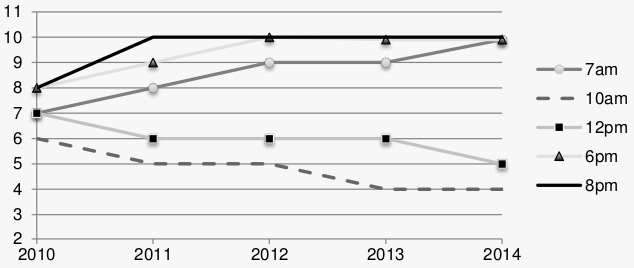
B. Average number of weekday students in Orange Yoga classes (2014)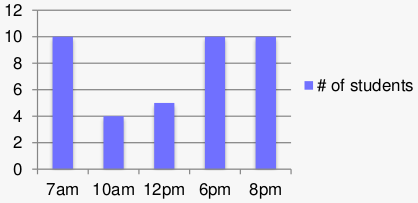
Exhibit 2. Weekend students
A. Average number of weekend students in Orange Yoga, 2010-2014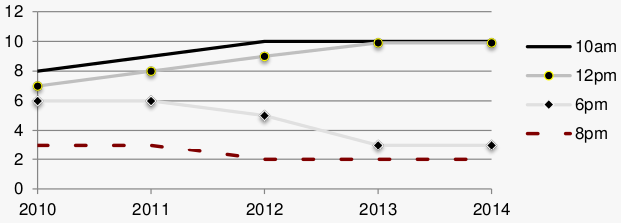
B. Average number of weekend students in Orange Yoga classes (2014)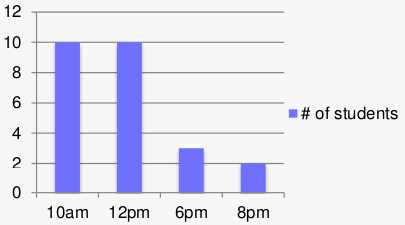
Chart Insights: The presentation of information on the four graphs is deliberately overwhelming. All candidates should realize that the top two graphs both pertain to weekday trends and the bottom two graphs pertain to weekend trends; strong candidates will structure their analysis separately for weekends and weekdays. No detailed calculations are necessary for this graph – just insights
Key Weekday Insights:
* Midday classes have a lower number of students than morning and evening classes
* This trend has become more pronounced over last 5 years
* Strong candidates will note that the 10am classes are not generating enough revenue to even cover teacher salary
Key Weekend Insights
* Has opposite profile of weekday classes: midday classes are much more popular than evening classes
* This trend has remained somewhat steady over past 5 years, though has become slightly more pronounced
* Strong candidates will note that evening classes are not generating enough revenue to even cover teacher salary.
A strong candidate will also notice that the max number of average participants peaks at 10 for both weekday and weekend classes. Strong candidates will also begin to hypothesize potential solutions, including restructuring class times to better meet the needs of clients, eliminating unprofitable classes, and perhaps adding additional classes/instructors in the evening.
Prompt #3: Increase Class Size
(Note: A strong candidate will notice that the max number of average participants peaks at 10 for both weekday and weekend classes. If they do not realize this, steer them towards this realization).
Prompt: “Good point. Yoga Jones currently allows a max of 10 students per class in order to keep the classes small. However, upon looking at her registration records, it appears that she is almost always turning away students for her weekday evening classes and weekend morning classes.
She would like to see if she can fit more students in her studio. Her studio is 13ft long and 21 ft wide. The average yoga mat is 6 ft long and 2 ft wide. Yoga Jones feels that the minimum distance between 2 mats should be one foot, and the minimum distance between a mat and a wall should be 6 inches. How many mats can she fit in her studio?”
Possible Answer:

(Note: The instructor does not need a mat)
There are two acceptable solutions:
* The max she can fit is 13, thought this very tricky to figure out. See chart above. The only real way that candidates can solve this is by drawing it out (see chart above). Some candidates may realize that each mat will need a total of 21 square feet (6 inches on each side) and the studio is 273 square feet. 273/21=13 (however very strong candidates will point out that this mathematical equation doesn’t always hold true spatially).
* If a candidate says 12, that’s fine as well, as long as they acknowledge that there will be wasted space in this configuration.
Prompt #4: Implementation
Prompt: Assume all current classes that currently have 10 students always have a lengthy waiting list. If Yoga Jones increases her class size, will this be enough to save her studio?
Possible answer:
The studio is currently losing $1,586 a month. Therefore the new students must bring in at least $1,586 in new revenue a month.
Cost
* Costs will remain the same
New Revenue if they calculated 12 as the max class size
* New students: 6 new students on weekdays, 4 new students on weekends.
* 6*22*$12 = $1584 extra weekday revenue
* 4*8*$12 = $384 extra weekend revenue
* $1968 total new revenue. Yes, this is now profitable (although barely).
New Revenue if the calculated 13 as the max class size:
* New students: 9 new students on weekdays, 6 new students on weekends.
* 9*22*$12 = $2376 extra weekday revenue
* 6*8*$12 = $576 extra weekend revenue
* $2952 total new revenue. Yes, this is now profitable.
Strong candidate should also suggest cutting classes that don’t cover variable costs to manage costs and adding additional evening classes to increase revenue.
Prompt #5: Recommendation
Prompt: What are your final recommendations to Yoga Jones?
Possible Answer:
All candidates should summarize their analysis and recommend increasing the max class size and eliminating classes.
Strong candidates will briefly summarize their analysis and results, but focus primarily on risks and next steps.
Risks include: losing long-term clients who valued flexible class times, upsetting clients who enjoyed small class sizes, and upsetting valued teachers whose classes were eliminated.
Next step include: Mitigating against risks mentioned above – but more importantly, exploring some of the other options that were outside of the scope of this case, including raising prices, diversifying products, etc….
6. Performance Evaluation
* What does the case test?
This case has both quantitative and qualitative elements. None of the math in this case is particularly tricky, but does require a lot of quick calculations, as well as tying multiple pieces together to get a holistic recommendation. It also tests creativity by encouraging candidates’ brainstorming and “thinking outside the box” ability.
* What should good interviewee be doing/asking/providing throughout the case?
There are many different potential paths that this case could take – a good candidate should test a variety of hypotheses with the interviewer throughout the case.
* Provide examples of what exceptional interviewees are doing throughout this case.
This case may be tricky for candidate who have no familiarity with yoga; however strong candidates should put themselves in
the shoes of the small business owner and try to see the problem for her perspective.
Exceptional candidates will always be thinking one step ahead, and provide next steps and hypotheses throughout the case.