American Airlines to Increase Number of Passengers per Flight
Case Type: improve profitability; math problem; estimate or guesstimate.
Consulting Firm: Arthur D. Little first round full time job interview.
Industry Coverage: airlines.
Case Interview Question #01134: The client American Airlines, Inc. (AA), commonly referred to as American, is a major airline company headquartered in Fort Worth, Texas. It is the world’s largest airline when measured by fleet size, revenue, scheduled passenger-kilometers flown, and number of destinations served.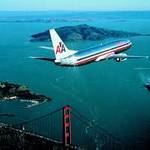
In 2011, due to a downturn in the airline industry, American Airlines’ parent company AMR Corporation filed for bankruptcy protection. In 2013, US Airways and American Airlines merged. Eventually operations were merged under one operating certificate to create the largest United States airline which kept the American Airlines brand name.
As a part of its recovery plan, American Airlines has asked your consulting firm to propose a plan to increase the number of passengers per flight. How would you approach figuring out the bottom line of increasing one passenger per aircraft in their domestic flights?
Possible Answers:
1. Case Overview
This case has a lot of calculations and information that may mislead the candidate. This information is included on purpose and the candidate should know what he/she have to use and what can be ignored.
The goal here is to calculate the additional profit of adding one passenger per flight (domestic flights only). After the candidate presents the framework and ask questions about cost and fares, provide Exhibit #1. If you want to make this case harder, do not provide the exhibit. Instead, give the Exhibit’s information upon request in a Q&A session.
2. Additional Information
A. Exhibit #1
Table 1: Aircraft models and capacity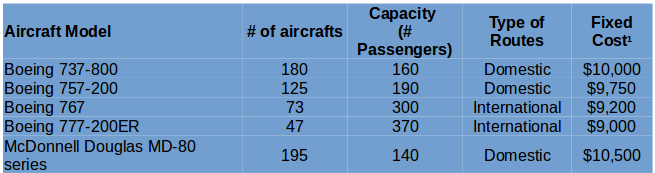
*1: Fixed cost per 1000 mile flight distance
Table 2: Average load factor, fares and time per flight
Table 3: Variable costs**2
**2: Variable costs are represented as a percentage of the round trip fare
B. Table Captions
Table 1:
* # of aircrafts: how many aircrafts AA has in its fleet.
* Capacity: number of passengers that each aircraft can fly.
* Fixed cost: fuel, maintenance and flight crew.
Table 2:
* Average load factor: average number of passengers/aircraft capacity
* Average round trip fare: this average includes first, business and coach classes
* Average time on air: time that the aircraft is actually flying
* Average time on land: average time to clean, refuel, and board the passengers
Note that the total time per flight is the average time on air + average time on land.
Table 3:
* All variable costs are a % of the round trip fare. That is, the variable cost for a domestic flight is 25% * $200 = $50, variable cost per flight = $50 / 2 = $25
3. Calculations
There is some useless information in the Exhibit. The candidate should ignore:
* All data regarding International flights: the case is about domestic flights
* Fixed Cost: the plane is flying anyway so the profit of an extra passenger should not consider the fixed cost.
The candidate should calculate the additional profit in dollars. Therefore, he/she may also ignore the aircraft capacity, and load factor. He/she can solve this case by using only the number of domestic aircrafts, average time on air, average time on land, variable costs, and round trip fares.
Assumption: the company operates 24 hours a day, and 360 days per year.
The easiest way to calculate the additional profit is calculating how many domestic flights AA operates per year and the profit per flight that the additional passenger brings.
Calculating the number of flights per year:
* # of aircrafts (domestic only): 180 + 125 + 195 = 500
* Average time per flight = average time on air + average time on land = 2 + 0.5 = 2.5 hours
* Average flights per day per aircraft = 24 hours / 2.5 hours = 9.6 (can be rounded to 10 per day)
* Total flights per year = # of aircrafts * average flights per day * 360 = 500 * 10 * 360 = 1,800,000 flights
Calculating the additional profit per flight that an additional passenger brings:
* Average fare per flight = round trip fare / 2 = $200 / 2 = $100
* Variable Cost = (10% + 10% + 5%) * $100 = $25
* Additional Profit per passenger = Revenue — Variable Cost = $100 – $25 = $75
* Additional profit per year = $75 * 1,800,000 = $135,000,000 = $135 MM
There are other ways to reach the same result. The calculations above show the easiest way. Help the candidate only if he/she gets stuck with the numbers.
4. Bonus Question
Question: Now that we know the impact of adding one passenger per flight, what can we do to achieve this goal? What else can be done to increase AA’s profitability?
Possible Answer:
This is a regular “what else” question. The candidate should mention some of the ideas bellow:
* Increase the # of passengers:
* Change pricing strategy
* Offer a better customer service
* Offer a better “frequent flyer” program (AA Advantage program)
Increase AA’s overall profitability:
* Negotiate fuel prices (fuel represents 30% of the operational cost)
* Negotiate with labor unions to reduce salaries/benefits for new hires
* Focus on the most profitable routes
* Discontinue unprofitable routes
This case does not require a final recommendation.
5. Performance Evaluation
Expected:
* Had a good structure/action plan to calculate the additional profit
* Correctly calculates the additional profit, but needed some assistance
Good:
* Completes all “Expected” requirements
* Correctly identifies the irrelevant data
* Could list at least 3 ideas to increase the number of passengers and 3 to increase the overall profitability
* Could keep the interviewer engaged during the calculations
Excellent:
* Completes all “Good” requirements
* Showed some knowledge of this market
* Could list at least 5 ideas to increase the number of passengers and 5 to increase the overall profitability
* Could drive the case and solve it without much help.