Retail Bank Santander to Grow Customer Base
Case Type: improve profitability; growth strategy.
Consulting Firm: Capital One first round full time job interview.
Industry Coverage: banking.
Case Interview Question #01044: The client Santander Bank (formerly Sovereign Bank) is a regional retail bank based in Boston, Massachusetts, United States. As a wholly owned subsidiary of the Spanish Santander Group, Santander Bank’s principal market is in the Northeastern United States. As of 2015, it operates 220 retail  banking offices, over 800 ATMs (including 400 in CVS pharmacies throughout the Northeast) and employs approximately 3,000 people. Santander Bank offers an array of financial services and products including retail banking, mortgages, corporate banking, cash management, credit card, capital markets, trust and wealth management, and insurance.
Recently, the client Santander Bank has begun facing threats from other regional banks, Internet-based financial services firms and other non-traditional firms. Deposits are declining and the bank has approached us to come up with a strategy to grow the bottom line. Walk me through some of the issues that you would consider and work streams you would set up in coming up with some recommendations.
Possible Answers:
1. Suggested Framework
Profitability framework: Profit = Revenue – Cost = Price * Quantity – Cost
* Price = Revenue per customer
* Quantity = Number of customers
* Cost = Overhead
2. Additional Information: (to be given to candidate if requested)
Client:
* Santander Bank is a well-established regional bank.
* Based in New England
* $100 million in profit
* 3 million customers, very loyal
* Acquisitions strategy
* Lots of products:
– Deposits/savings accounts
– Small investments
– Credit cards
– Mortgages
* The bank is known for trust and security.
3. Options to Grow
* Grow revenue per customer by increasing the number of relationships or products/services that the client has with its existing customer base — a customer loyalty enhancing strategy.
* Increase the number of customers by offering a wider variety of products.
* Decrease customers that are not the high revenue generating customers — eliminate unprofitable customers from its base so that the number of customers goes down, while revenue per customer goes up.
* Increases number of customers and increase the relationships or products/services with its customers.
* Decrease costs.
Each of these strategies will result in the bottom line increasing, but the choice of the strategy will be based on the client’s core competencies and the competitive assessment, along with a consideration of how the industry is likely to evolve in the future.
4. Sample Interview Transcript
Interviewer: Walk me through some of the issues that you would consider and work streams you would set up in coming up with some recommendations.
Candidate: I’d like to structure the analysis along three broad areas, which would also form the work streams. I would like to better understand the client’s strengths, particularly their brand equity, customer reach and their history. Then I’d like to evaluate competitive trends, products and services offered and the value proposition that these competitive firms offer. Finally, I’d like to design the capabilities that the client will have to establish in order to grow their bottom line.
Interviewer: OK. Where would you like to start?
Candidate: Could you tell me more about our client, particularly about their customers, brand and history?
Interviewer: Sure. The client is a well-established bank based in New England. They have about 3 million customers and an acquisitions strategy that has been reasonably successful. They offer a slew of products including deposits/savings accounts, small investments, credit cards and mortgages. However, they have been laggards in e-Banking.
Candidate: Do we know how their customers perceive their brand?
Interviewer: Well, they are a reputed and established firm. They are known for trust and security. They have chosen to remain a regional bank and consequently customers are quite loyal.
Candidate: I see. I’m particularly intrigued by the fact that they are laggards in e-Banking, which segues nicely into the next area I’d like to explore — competition. Can you tell me more about the competitive threats they are facing?
Interviewer: Competition has intensified both from traditional firms, particularly other regional banks and also from new, non-traditional firms. As you’ve probably guessed, Internet-based financial service firms are able to offer a better perceived value proposition to customers and the client feels that there is a strong threat of losing loyal customers.
Candidate: I think I have a good feel for the client’s competencies as well as the emerging competitive threats. Do we know if the client is looking for new product ideas?
Interviewer: Well, that would surely be one area to explore. It’s not clear if that is the primary focus of the client. How would you help the client identify how to prioritize the various options?
Candidate: I’m sure this is not totally comprehensive, but I’d identify the major product lines the client offers customers. For sake of argument, let’s look at three products/services — banking products like savings accounts, brokerage services and say, retirement accounts. For each of these products/services, I’d then identify the different channels available — branches, the Internet, etc. For each of these channels, I’d undertake an analysis of value versus convenience. This would help segment the various products/services that the client can offer into various levels of service quality and value proposition.
Interviewer: That’s interesting. What next?
Candidate: With an approach I just described, I’d like to move to the final area that I wanted to discuss — capabilities. If we rank-ordered the client’s customers by revenue they contribute and plot a chart of revenue per customer and the number of customers, the chart would probably look something like this. I’m not entirely sure if the curvature is exactly as shown. Let’s assume this is illustrative for purposes of discussion.
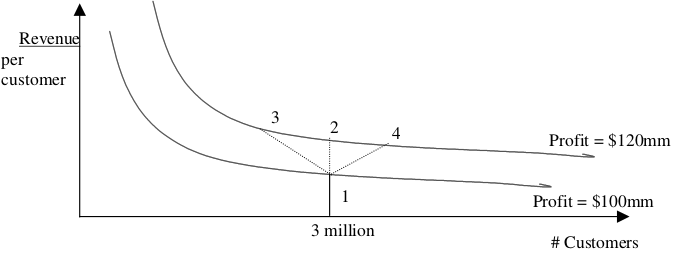
If the client currently makes $100 million in profit, with 3 million customers, they are at point 1 on this chart. Their objective is to move to points 2, 3 or 4 at a higher level of profit, say $120 million.
Now, point 2 represents increasing the revenue per customer without bringing in more customers. We can think of this strategy as increasing the number of relationships or products/services that the client has with its existing customer base — a customer loyalty enhancing strategy.
Point 3 represents an attritive strategy — eliminate unprofitable customers from its base so that the number of customers goes down, while revenue per customer goes up. This is a cherry-picking strategy.
Point 4 represents an acquisitive strategy where the client increases its customer base while simultaneously increasing the relationships or products/services with its customers.
Each of these strategies will result in the bottom line increasing, but the choice of the strategy will be based on the client’s core competencies and the competitive assessment we have undertaken, along with a consideration of how the industry is likely to evolve in the future.
Interviewer: This is great. So if you were in a meeting with the bank’s CEO, what would your recommended course of action be?
Candidate: Based on our discussion, my preference is to recommend the strategy that leads to Point 4 — grow the customer base as well as deepen the relationships with the customers to enhance loyalty. This will probably be most successful in the long run. I must admit that this recommendation is based on our 20-minute discussion and wonder if there are other areas I haven’t explored.
Interviewer: The point of this exercise is not to come up with a right answer. You did a good job. Thanks.