How to Increase Profitability for Commodity Widget Maker?
Case Type: improve profitability.
Consulting Firm: PricewaterhouseCoopers (PwC) first round full time job interview.
Industry Coverage: manufacturing.
Case Interview Question #00972: Our client Boozy Co. is an American manufacturing company that produces commodity widgets such as metal door knobs. Their profits have declined over the last three years. Boozy Co. has engaged our consulting firm to help them with this issue. The two questions facing them are:
1. Determine why profits have declined.
2. What can Boozy Co. do to restore profitability?
How would you go about it?
Additional Information:
Here is some of the information that a candidate may ask for; provide only if the candidate asks.
a. More about the client Boozy Co.
* They manufacture true commodity products, and have no ability to differentiate.
* Pricing has held constant for each of their product lines.
* Overall quantity has remained constant at 100% effective capacity.
b. The Market
* No substitutes in the market (make it clear this is not a “five forces” case).
* Overall market demand has remained constant.
* COGS and SG&A should be allocated pro rata across total units produced.
* There are 2 other big competitors in the market.
* Our competitor’s products are very similar to ours and are priced similarly, too.
* Our competitors have limited differentiation when it comes to the product, promotions, or price.
Possible Answer:
1. Suggested Framework
The candidate should, at some point, draw out or at least speak to the profitability framework:
Profits = Revenue — Cost = (Volume * Price) — (Fixed cost + Variable Cost)
When the candidate discusses revenue/historical company performance – provide Exhibit 1.
Exhibit 1. Boozy Co. Summary Income Statement (in $ million)
| Year | 2012 | 2013 | 2014 |
| Net Sales | $100 | $90 | $80 |
| Cost of Goods (COGS) | $60 | $60 | $60 |
| Gross Profit | $40 | $30 | $20 |
| SG&A | $30 | $30 | $30 |
| Operating Income (EBIT) | $10 | 0 | ($10) |
2. Detailed Analysis
If, after seeing Exhibit 1, the candidate asks about the product mix, provide Exhibit 2. If the candidate does not ask about different products under the Boozy portfolio, drive the candidate towards factors that drive revenue – provide Exhibit 2. The candidate must ask about product mix before being given Exhibit 2.
Exhibit 2. Boozy Co. Product Mix
| Year | 2012 | 2013 | 2014 |
| Price | |||
| Snoozie | $5 | $5 | $5 |
| Coozie | $10 | $10 | $10 |
| Quantity (millions) | |||
| Snoozie | 10 | 12 | 14 |
| Coozie | 5 | 3 | 1 |
Explain to the candidate that the Snoozie and Coozie are manufactured interchangeably with the same machines. Let the candidate drive forward on calculations of individual product profitability. This can only be accomplished if, after seeing Exhibit 2, the candidate recognizes that the cost component is still outstanding – provide Exhibit 3.
Exhibit 3. Boozy Co. Unit Costs vs. Competitors: SG&A + materials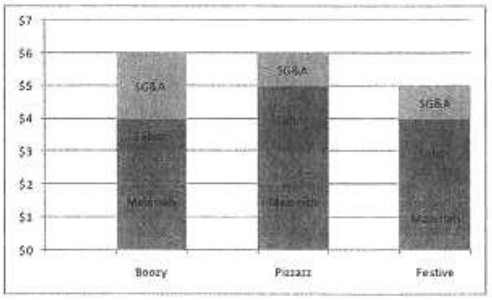
a. The candidate should recognize that on a fully-loaded basis, we lose money on each Snoozie ($6 total cost, $5 price). Management didn’t realize this because they failed to allocate SG&A.
b. If demand has remained constant, and price is the only differentiator, Coozie is overpriced and Snoozie is under-priced. Upon reviewing relative cost position slide, the candidate should attack SG&A first and raw materials second and offer thoughtful, specific ideas about how to reduce costs.
Other insights from Exhibit 3:
Higher performing candidates will also consider that higher materials/lower labor costs may be related. For example, some locations may have low cost labor, but be far away from raw materials. Or, a highly automated manufacturing process may require less labor, but more materials, etc. It may even be that competitors define each category differently – some costs we put in SG&A may be in Festive’s “labor”. People say some pretty smart things looking at that very simple graph.
Interviewer: Instruct the candidates to recalculate or speak to changes in the income statement given a product mix change. Higher performing candidates should address the reality that over the long term, commodity prices converge to costs, so Boozy Co. must lower costs to compete.
3. Recommendations
Interviewer: The client has asked us for our recommendation. What would you tell the client?
Responses will include a discussion surrounding the rationale of a shift in strategy to become the low-cost producer in the industry, and/or a broader discussion of enhanced market fragmentation to take advantage of its product mix. Additionally, the candidate must appeal to both the short-run and long-run options. The short term fix (raise price on Snoozie, and lower costs on Coozie to adjust product mix) should be distinctive from any long-term solutions, which can be a bit more creative, surrounding strategy shifts and implementation.
4. Additional Considerations
Interviewer: What are some of the potential risks?
Here are some potential answers:
* Is our labor cost component lower, and sustainable? Will there be significant capital expenditures due in the near future to maintain/upgrade facilities?
* Any change in operations may result in modest product deficiencies and/or distribution issue – what is our recourse under this scenario? This may result in a loss of goodwill.
* Running machines at capacity may result in faster wear and tear, resulting in added maintenance expenditure.