TD Bank to Charge Monthly Fee for Checking Account
Case Type: improve profitability.
Consulting Firm: McKinsey & Company first round full time job interview.
Industry Coverage: banking.
Case Interview Question #00819: Our client TD Bank, N.A., is a United States national bank headquartered in Cherry Hill, New Jersey. It offers retail banking services in 15 states and Washington, D.C. TD Bank has a large retail footprint and offers a mix of services to end customers (checking, debit cards, credit cards).  They also have loan centers to sell mortgages in the same markets. The bank currently serves 15 million customers.
Our client TD Bank has historically been very profitable, but increased regulation from the Federal Government and the recent downturn in the U.S. economy have caused the bank to see a sharp decline in profitability. The client has engaged McKinsey & Company to help determine the next steps for its business and has asked us to assess ways they can increase profits within the next 12 months. How would you go about this case?
Additional Information: to be provided upon request
Ensure the candidate is familiar with how a bank earns its profits (e.g. the spread between what they lend money out at and borrowing costs, fees on various services).
Note that this is a typical McKinsey style interviewer-led case. There are eight questions that the Interviewer will ask the Interviewee.
Question #1: What are some of the ways the bank can increase profits in the next 12 months?
Possible Answer:
A good answer is structured and contains a comprehensive set of ideas to both reduce costs and boost revenues as well as clear examples. The interviewee should use a Profitability framework (Profits = Revenues – Costs) to approach this problem. Answers include but are not limited to:
I. Reduce Costs
a. Fixed Costs
- Reduce under-performing branches (close branches, lease branches to other banks)
- Reduce workforce (e.g., push greater use of online channels for banking, outsource functions)
- Consolidate the branches and the loan centers
b. Variable Costs
- Reduce costs associated with transactions (paper free, decrease error rate)
II. Increase Revenue
a. Quantity
b. Current Customers
- Cross-sell different products (home purchase mortgages, refinancing, credit card, debit card, money market, advisory services)
- Change product mix to higher revenue products
- Get rid of unprofitable customers
c. New Customers
- Increase Number of customers
- Product Mix
- Launch new products
d. Price
- Increase bank fees (Debit card fees, ATM fees, call center fees)
- Raise rates charged
Question #2: We have worked with our client TD Bank to narrow down their options to two choices. The first is shutting down unprofitable retail locations, the second is a better customer segmentation strategy. Let’s explore both. First, what are some of the risks with shutting down branch locations?
Possible Answer:
There are a number of ways to think this through — look for the structure in how the candidate responds. A good answer includes, but is not limited to:
a. Near Term
- Poor PR
- Legal/contractual complications
- Extra costs (severance)
- Lose a portion of customers who bank through that branch
- Selling off assets could scare investors
b. Long Term
- What happens when the market rebounds?
Question #3: The second option the bank is considering is a better retail segmentation strategy: What segments do you think a retail bank has?
Possible Answer:
This response could have a lot of answers. Look for clear delineation between customers who are profitable and unprofitable and then list characteristics of each (i.e. Segment 1 is mass affluent and is highly profitable, uses checking accounts, has a money market account, and has a mortgage with the bank; they are low cost as they generally use ATMs and the internet to manage their transactions; Segment 2 is lower income, keeps a small balance in checking, uses tellers and call centers often) etc.
Note: Ensure the candidate does not spend too long on this question.
Question #4: Can you take a look at the below chart and walk me through what the bank is experiencing? Please walk the interviewee through any questions they have on the chart in Exhibit 1.
Exhibit 1. Our client TD Bank has 5 distinct groups of customers (Annual $ per customer*)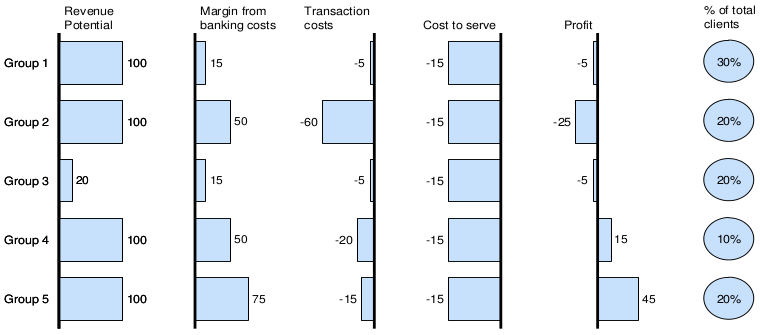
* 15,000,000 customers
Possible Answer:
Key insights include, but are not limited to:
- Only 30% of the bank’s customers are currently profitable
- 20% of the banks customers have low revenue potential and could be eliminated
- Our client needs to change the mix of products from group 1 and 2.
Question #5: What is the average annual profitability of a customer?
Possible Answer:
| Category | Profit ($) | Percent of clients | Weighted profitability |
| Group 1 | -5 | 30% | -$1.50 |
| Group 2 | -25 | 20% | -$5.00 |
| Group 3 | -5 | 20% | -$1.00 |
| Group 4 | 15 | 10% | $1.50 |
| Group 5 | 45 | 20% | $9.00 |
| Total | N/A | 100% | $3.00 |
Average annual profitability of a customer = $3.00
Question #6: What is the annual bank profitability?
Possible Answer:
Total Customers = 15,000,000
Average Profit per customer = $3.00
Total Profit = 15M * $3.00 = $45M
Note: If the interviewer decides to calculate each group out individually, push them to look for shortcuts.
Question #7: Our client has decided to institute a $0.85 fee each month for all checking accounts. We have advised them that they will lose a number of customers. We expect the following % of customers to remain (read this chart to interviewee):
Percent of customers that remain
- Group 1: 60%
- Group 2: 40%
- Group 3: 20%
- Group 4: 60%
- Group 5: 50%
What is the new annual profitability per customer?
Possible Answer:
| Segment | Profit ($) | % of Customers | % customers that will stay | # of remaining customers | Profit per group (without fee) | Profit from fees (@$10 per year) | Total profit per segment |
| Group 1 | -$5 | 30% | 60% | 15M*0.3*0.6 = 2.7M | -$13.5M | $27M | $13.5M |
| Group 2 | -$25 | 20% | 40% | 15M*0.2*0.4 = 1.2M | -$30M | $12M | -$18M |
| Group 3 | -$5 | 20% | 20% | 15M*0.2*0.2 = 600K | -$3M | $6M | 3M |
| Group 4 | $15 | 10% | 60% | 15M*0.1*0.6 = 900K | $13.5M | $9M | $22.5M |
| Group 5 | $45 | 20% | 50% | 15M*0.2*0.5 = 1.5M | $67.5M | $15M | $82.5M |
| Total | N/A | 100% | N/A | 6.9M | $34.5M | $69M | $103.5M |
New average Profit per Customer = $103.5M/6.9M = $15
Note 1: If the interviewee is running out of time, help them along to ensure they get to conclusion, e.g. ask them for their approach.
Note 2: Feel free to let the interviewee round off numbers here, e.g. suggest $0.85 per month should become $10 per year.
Question #8: You are walking down the hall and run into the CEO of TD Bank, he wants to know your recommendation. What would you tell him?
Possible Answer:
A good answer includes, but is not limited to:
Conclusion: The client TD Bank should institute a bank fee in order to meet the initial goal of increasing profits. This is the quickest way to earn new streams of revenue, while segmenting out the unprofitable customers. By instituting a fee the client will be able to increase profit by 5x per customer on an annual basis.
Note: The interviewee should include a detail or two on each group and how they are able to increase profits (e.g. Group 3 was losing $3M per year we are now earning $3M in profit from them on an annual basis).
Risks
- Bad PR
- High transaction costs as people try to figure out if they are affected
- Estimates could be off
- Lose customers that could become profitable in the future
Next steps
- Move forward with instating the fee
- Look at exempting certain groups from the fee.