OVS Improves Profitability of Vending Machine Services
Case Type: improve profitability; reduce costs.
Consulting Firm: Bain & Company final round full time job interview.
Industry Coverage: office equipment; electronics.
Case Interview Question #00796: The year is 1999. The client Office Vending Services, Inc. is the market leader in providing vending machine services to office buildings in the United States. The company’s business services provided include sales and delivery of vending machine products, restocking of machines, 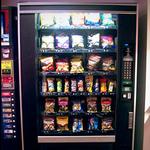 and repair of faulty equipment. A vending machine is a machine that dispenses items such as snacks, candies, beverages, alcohol, cigarettes, lottery tickets to customers automatically, after the customer inserts currency or credit into the machine.
The client OVS’s profits are substantially down in the business for the last two years (Year 1996 – 1998). The CEO of Office Vending Services, Inc. has hired your consulting firm to assess the root causes of the profitability decline, and to suggest possible course of action to improve its profitability. How would you go about analyzing this case?
Additional Information: (to be provided to candidate upon request)
Exhibit 1. Office Vending Services, Inc. revenue (1996-1998) 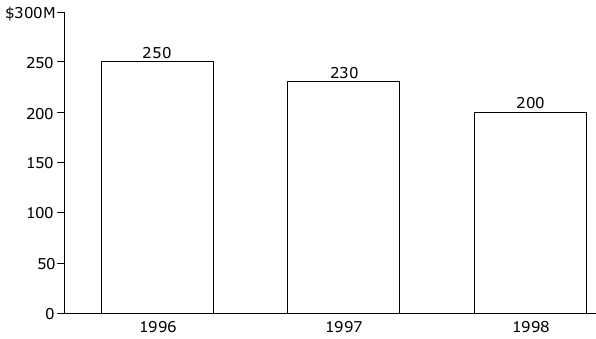
Source: Office Vending Services, Inc. Financial Statements
Exhibit 2. Office Vending Services, Inc. cost (1996-1998)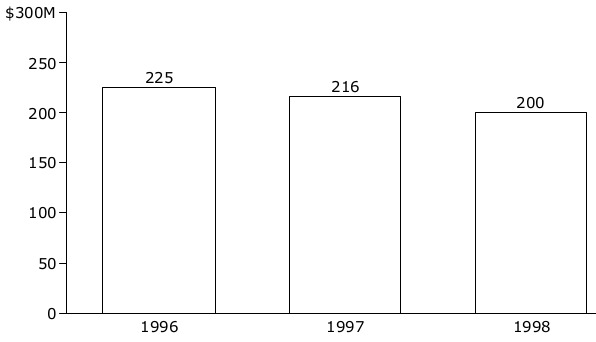
Source: Office Vending Services, Inc. Financial Statements
Exhibit 3. Office Vending Services, Inc. volume sold (1995-1998)
Volume Sold (Millions of Deliveries)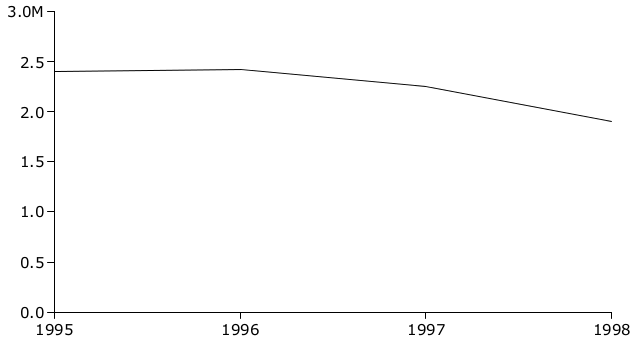
Source: Office Vending Services, Inc. Financial Reports
Exhibit 4. Office Vending Services, Inc. historical pricing (1995-1998)
Office Vending Services Average Price (Dollars per Delivery)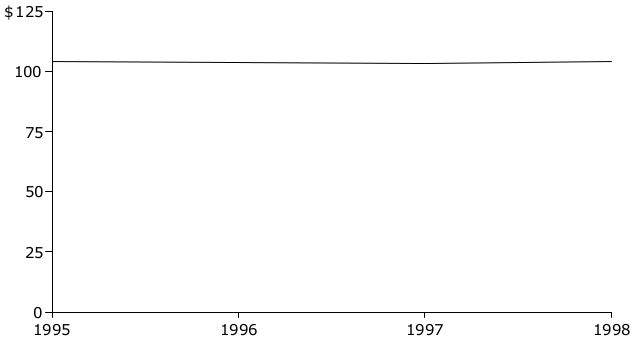
Source: Office Vending Services, Inc. Pricing Data
Exhibit 5. Office Vending Services, Inc. market share and growth trend (1996-1998)
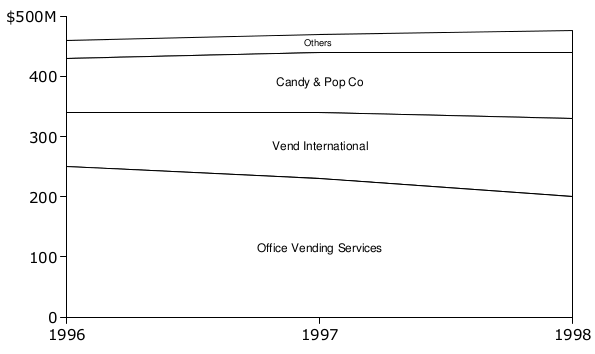
| Company | Percentage Change (1996-1998) |
| Office Vending Services | (20%) |
| Vend International | 44% |
| Candy & Pop Co. | 22% |
| Others | 17% |
| Total | 3% |
Source: Market Research; Company Annual Reports; Office Vending Services Financials
Exhibit 6. Customer satisfaction (Importance/Performance: 1=Low, 10=High)
| Attribute | Importance | Office Vending Services | Vend International | Candy & Pop Co. |
| Price | 10 | 4 | 8 | 7 |
| Product Variety/Selection | 6 | 10 | 5 | 6 |
| Delivery Reliability | 9 | 5 | 10 | 8 |
| Machine Service/Repair | 3 | 9 | 4 | 5 |
| Complaint Resolution | 5 | 7 | 5 | 4 |
Source: Bain Customer/Market Research for Office Vending Services (n=3500)
Exhibit 7. Customer Satisfaction
Customer Rating of Importance/Performance (1=Low, 10=High)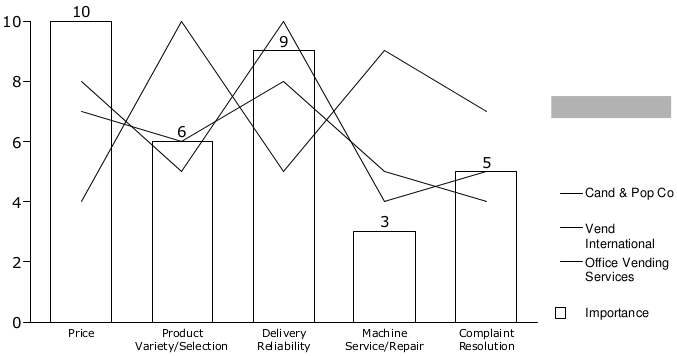
Source: Bain Customer/Market Research for Office Vending Services (sample size N=3500)
Exhibit 8. Competitor Comparison (Year 1998)
| Company | Revenue | Cost of goods sold | SG&A expense | Direct labor (delivery) | Direct labor (repair) | Other costs |
| Office Vending Services | $200M | $70M | $60M | $30M | $30M | $10M |
| Vend International | $130M | $35M | $30M | $30M | $17M | $5M |
| Candy & Pop Co. | $110M | $32M | $22M | $23M | $15M | $6M |
Source: Financial Statements & Annual Reports
Exhibit 9. Office Vending Services, Inc. cost per delivery (versus competitors)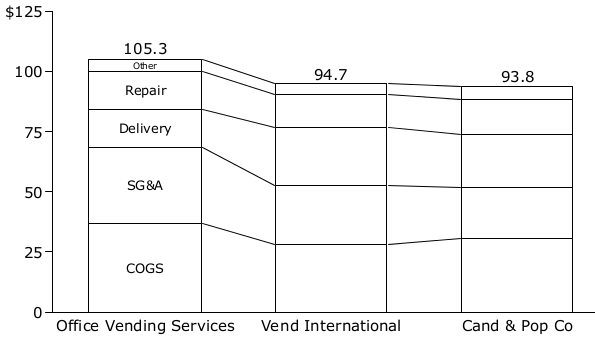
Source: Financial Statements & Annual Reports
Exhibit 10. Office Vending Services, Inc. cost structure (Historical trend, 1996-1998)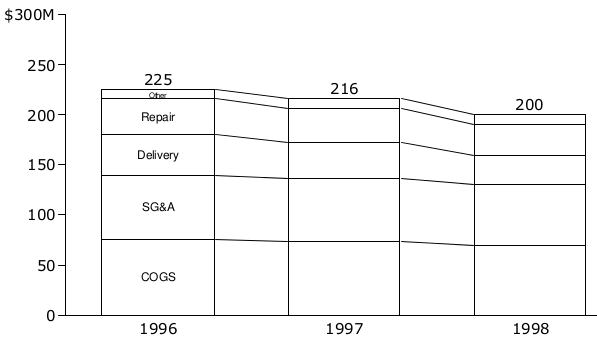
| Percentage Change (1996-1998) | |
| Total: | (11%) |
| Other: | 0% |
| Repair: | (14%) |
| Delivery: | (25%) |
| SG&A: | (8%) |
| COGS: | (7%) |
Source: Office Vending Services Financial Statements
Possible Answer:
1. Suggested Framework
There are many ways to go about solving this problem, e.g. the 3C’s framework (Costs, Customers, Competition). Key points to bring up in a framework include:
- What is happening with OVS’s revenue and costs? The interviewer can ask interviewee: “what do you think are the major cost buckets for a firm like OVS?” Examples: Delivery costs, Cost of goods sold (COGS), Selling, general and administrative (SG&A), etc.
- Customers — Are wants and needs being met?
- Competition — How is the competition doing? Are there new entrants? Big rivals? Substitutes?
2. Key slide take-aways
Exhibit 1 — OVS revenues have been decreasing for the past 2 years; rate of revenue decrease is increasing; Down 8% from ’96 –’97; Down 13% from ’97 — ’98. The interviewee should begin to think about what the drivers of the revenue decrease
are and may ask for if a revenue breakout is available.
Exhibit 2 — OVS costs have been decreasing for the past 2 years as well; rate of cost decrease is increasing, but is not keeping pace with the rate of revenue decline; Down 4% from ’96 – ’97; Down 7.5% ’97 — ’98. The interviewee should begin to think about where the cost reductions are coming from and what the drivers are. May ask for a cost breakout for OVS.
Exhibit 3 — Volume of deliveries are dropping over the past few years. What is the driver? Can have the interviewee speculate.
Exhibit 4 — Average price per delivery has remained stable; so revenue per delivery has not dropped.
Exhibit 5 — OVS is the dominant player in market but has been losing market share — 20% over the past 2-years. The interviewee should be able to estimate the competitors’ market size, as well as the percentage of the market OVS currently has.
- OVS Revenue: $200M (40% of market)
- Vend International Revenue: $130M (26% of market)
- Candy & Pop Revenue: $110M (22% of market)
- Other Revenue: $60M (12% of market)
It is also important for the interviewee to see that Vend International has grown the fastest at 40%. It will be important to understand how Vend International has grown — what does Vend International do well that has allowed them to be so successful over the past few years?
Exhibit 6 — Should see what attributes are important to customers and how OVS ranks versus their competitors. The top 2 for customers (Price and Delivery Reliability) are where OVS scores the lowest. Conversely, Vend scores the highest in these two categories. Additionally, OVS scores very well in Product Variety and Machine Service/Repair, yet these are not nearly as important to customers. The interviewee should begin to make links between what has allowed Vend to grow (meeting customer needs) while OVS loses market share.
Exhibit 7 — Same as Exhibit 6, just in graphical format; same key information should be obtained.
Exhibit 8 — There are many take-aways form this slide.
First, the interviewee should see that OVS’s COGS, SGA and Repair costs are significantly higher (roughly 100%) than the competition. Additionally, OVS’s costs for delivery are in line with their competitors, despite higher market share — which would correlate to the poor customer satisfaction when it comes to delivery. This may begin to suggest that OVS could reduce costs in COGS (reduce product variety since it isn’t as important to customers; get better prices if buying larger volumes of fewer products), reduce repair costs (again, not as important to customers) and reallocate some of this to delivery to increase customer satisfaction. SGA may also see a slight reduction as complexity in ordering, labor and other line items as fewer products are ordered and repairs are reduced.
Also, the interviewee can calculate each firm’s profit margin in order to compare them in a more direct manner.
- OVS: (200-200)/200 = 0%
- Vend International: (130-117)/130 = 10%
- Candy & Pop: (110-98)/110 = 11%
This clearly shows that OVS’s profit margin is non-existent and that their competitors are running a more efficient operation.
Exhibit 9 — OVS’s cost per delivery is 9.5% higher than the competition. Also, the breakout of the overall costs within each delivery differs:
- OVS’s COGS and SG&A per delivery are higher (roughly 70% of total delivery cost versus 50%)
- OVS’s delivery bucket of the overall cost per delivery is roughly half the cost of the competition — again, not meeting customers’ need and spending less than other vendors.
Exhibit 10 — OVS has been reducing costs across the board, but the largest reduction has come from deliveries — which is clearly impacting the overall business. The small decreases in the other large buckets, has not significantly impacted overall costs.
3. Conclusion
What is the overall issue with OVS’s profitability?
a. OVS’s profit margin is current 0% compared to 10% and 11% for two largest competitors.
b. OVS is reducing costs, but revenue is dropping faster than costs are
- OVS has reduced costs significantly in Delivery, yet this is the most important attribute to customers.
- OVS has not reduced costs much in COGS, yet Price is very important to customers.
c. Not meeting customers’ needs:
- Price and Delivery are the most important but OVS scores lowest in these categories; competitors are meeting customers’ needs and are stealing share away from OVS.
- OVS’s spending on Product Variety and Repair are significantly higher than the industry spends and are in areas that customers do not value as much — need to reallocate and reduce.
Potential course of action to improve profitability:
a. Look to reduce COGS, SG&A and repair costs
- A reduction in product variety could decrease COGS through economies of scale – OVS would purchase higher volumes of fewer products, lower cost/unit.
- Reduction in variety may also reduce costs of delivery as there would be fewer products to carry in vehicles (more deliveries possible) and may reduce the time/complexity of refilling a machine.
b. Increase spend on delivery to improve customer satisfaction (more research needed!)
- More drivers
- Better vehicles
- More efficient delivery routes