Office Vending Services to Reduce Number of Products Offered
Case Type: improve profitability; reduce costs.
Consulting Firm: Bain & Company final round full time job interview.
Industry Coverage: office equipment; electronics.
Case Interview Question #00768: A vending machine is a machine that dispenses items such as snacks, candies, beverages, alcohol, cigarettes, lottery tickets to customers automatically, after the customer inserts currency or credit into the machine. The client Office Vending Services, Inc. is the market leader  in providing vending machine services to office buildings in the United States. The company’s business services provided include sales and delivery of vending machine products, restocking of machines, and repair of faulty equipment.
The year is 1999. The client’s profits are substantially down in the business for the last two years (1996 – 1998). The CEO of Office Vending Services, Inc. has hired consulting firm Bain & Company to assess the root causes of the profitability decline, and to suggest course of action to improve its profitability. How would you go about analyzing this case?
Additional Information: (to be provided to candidate upon request)
Exhibit 1. Office Vending Services, Inc. revenue (1996-1998) 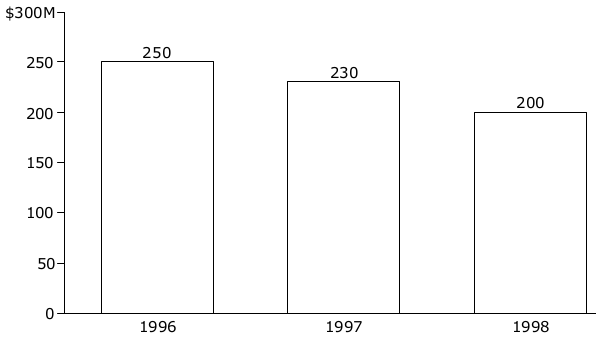
Source: Office Vending Services, Inc. Financial Statements
Exhibit 2. Office Vending Services, Inc. cost (1996-1998)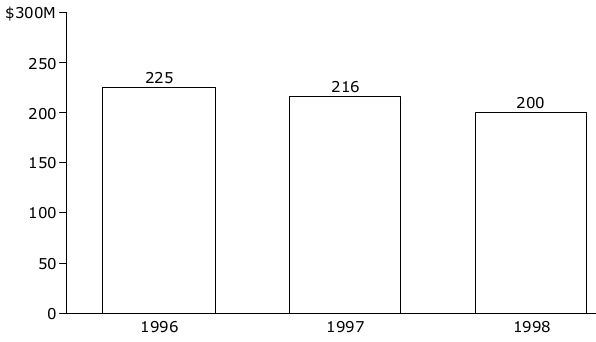
Source: Office Vending Services, Inc. Financial Statements
Exhibit 3. Office Vending Services, Inc. volume sold (1995-1998)
Volume Sold (Millions of Deliveries)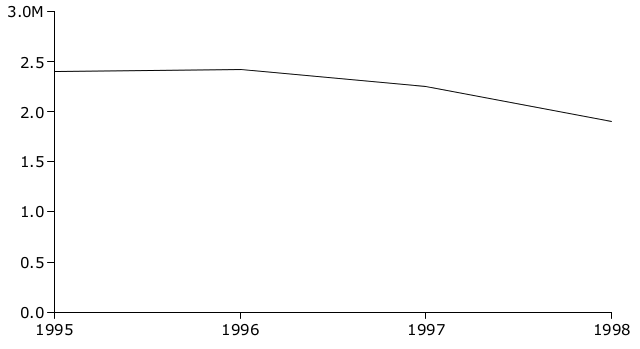
Source: Office Vending Services, Inc. Financial Reports
Exhibit 4. Office Vending Services, Inc. historical pricing (1995-1998)
Office Vending Services Average Price (Dollars per Delivery)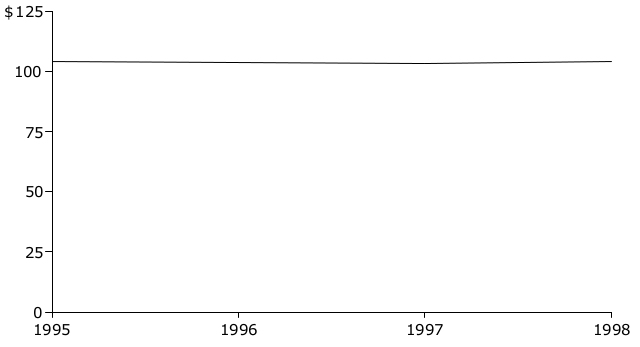
Source: Office Vending Services, Inc. Pricing Data
Exhibit 5. Office Vending Services, Inc. market share and growth trend (1996-1998)
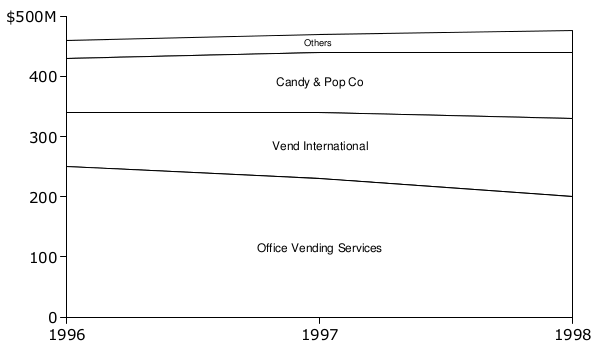
| Company | Percentage Change (1996-1998) |
| Office Vending Services | (20%) |
| Vend International | 44% |
| Candy & Pop Co. | 22% |
| Others | 17% |
| Total | 3% |
Source: Market Research; Company Annual Reports; Office Vending Services Financials
Exhibit 6. Customer satisfaction (Importance/Performance: 1=Low, 10=High)
| Attribute | Importance | Office Vending Services | Vend International | Candy & Pop Co. |
| Price | 10 | 4 | 8 | 7 |
| Product Variety/Selection | 6 | 10 | 5 | 6 |
| Delivery Reliability | 9 | 5 | 10 | 8 |
| Machine Service/Repair | 3 | 9 | 4 | 5 |
| Complaint Resolution | 5 | 7 | 5 | 4 |
Source: Bain Customer/Market Research for Office Vending Services (n=3500)
Exhibit 7. Customer Satisfaction
Customer Rating of Importance/Performance (1=Low, 10=High)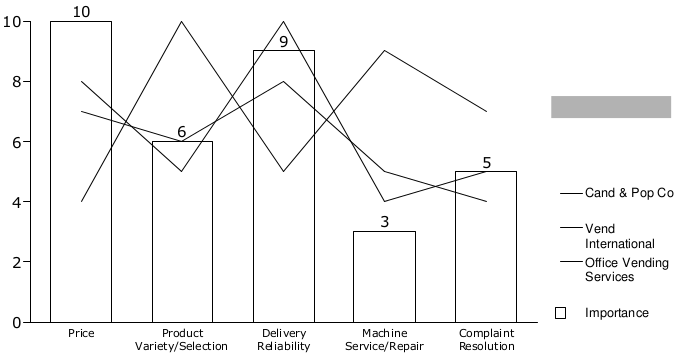
Source: Bain Customer/Market Research for Office Vending Services (sample size N=3500)
Exhibit 8. Competitor Comparison (Year 1998)
| Company | Revenue | Cost of goods sold | SG&A expense | Direct labor (delivery) | Direct labor (repair) | Other costs |
| Office Vending Services | $200M | $70M | $60M | $30M | $30M | $10M |
| Vend International | $130M | $35M | $30M | $30M | $17M | $5M |
| Candy & Pop Co. | $110M | $32M | $22M | $23M | $15M | $6M |
Source: Financial Statements & Annual Reports
Exhibit 9. Office Vending Services, Inc. cost per delivery (versus competitors)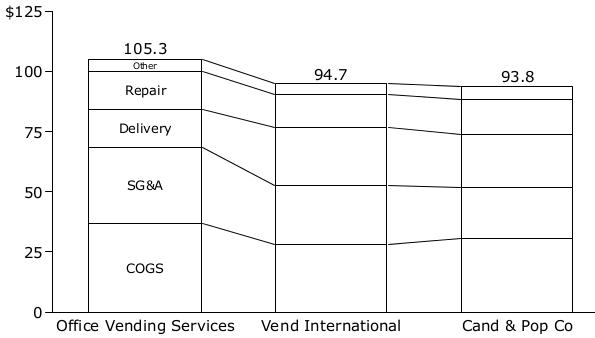
Source: Financial Statements & Annual Reports
Exhibit 10. Office Vending Services, Inc. cost structure (Historical trend, 1996-1998)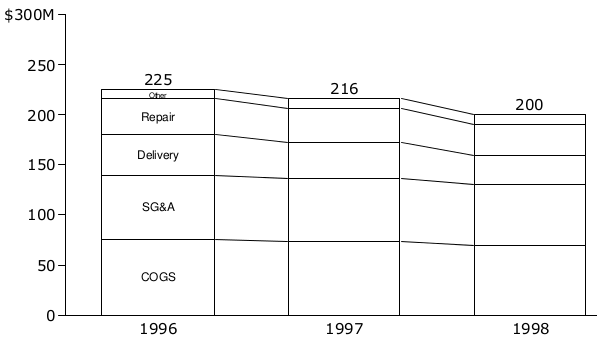
| Percentage Change (1996-1998) | |
| Total: | (11%) |
| Other: | 0% |
| Repair: | (14%) |
| Delivery: | (25%) |
| SG&A: | (8%) |
| COGS: | (7%) |
Source: Office Vending Services Financial Statements
Possible Answer:
Step 1: Identify the critical issues
Interviewer: “What do you think are the critical issues facing this client?”, or, “Where would you focus your efforts at this client?”
Reasonable Answers:
The client has identified the decline in profitability as the most important issue. I’d like to investigate how revenues and costs have changed to answer this question.
Better Answer:
The client has identified the decline in profitability as the most important issue.
- I’d like to investigate how revenues and costs have changed over time to answer this question.
- After we understand what has changed from a financial perspective, I’d like to look at how the customer base/preferences have changed in addition to competitive forces in the industry to understand the root cause of the client’s decline in profitability.
Potential Pitfalls:
Ignoring or missing key information presented up front
- I think the most critical issue is determining how the client can grow their business.
Jumping to a conclusion without supporting data.
- A decline in profitability must be due to their failure to control costs.
Failing to summarize the situation and diving into a detailed data request
- I’d like to look at the income statements for the past 8 quarters.
Step 2: Specify an analytic framework
Interviewer: “How would you approach this problem?”, or, “Specifically, what would be the key elements of your analysis?”
Useful Frameworks:
After identifying profitability as the key issue under consideration, the interviewee should be very explicit about how they would like to proceed to answer the question. There are two frameworks which an interviewee may find useful in this case:
a. Profitability Framework
Interviewees who use this framework will quickly uncover that a decline in unit sales has caused a decline in revenue and will likely hypothesize that a failure to cover fixed costs is causing costs (as a percentage of sales) to increase.
Interviewees who use this framework will be less likely to fully investigate the change in customer preferences or competitive landscape to which the client must respond.
b. 3C’s
Users of this framework may have a more difficult time driving towards the sales decline and fixed cost leverage issues than those which use the profitability framework.
However, the 3C’s framework is a great way to explore the customer and competitor issues here.
Potential pitfalls:
Picking an inappropriate framework. For instance, using Porter’s Five forces would indicate that the interviewee likely does not grasp the key issues in the case.
Not fully exploring one portion of the framework before moving on / jumping around in your framework. For instance, asking about price, moving to COGS, then returning to sales volume and finishing with SG&A.
Step 3: Prioritize/develop hypothesis
Interviewer: “So, what issue would you pursue first?”, or, “Which do you think is the most leveraged area for analysis?”
Good Response: (based on the profitability framework)
When this question is asked, it is a sign that the interviewee has uncovered what has changed with respect to revenue and costs and is being prompted to suggest a line of analysis which will help them drive toward a recommendation.
- I think the most important issue facing the client is the decline in unit sales which are responsible for the decrease in revenue. My hypothesis is that this decline in demand is responsible for a decrease in capacity utilization and/or leverage of other fixed costs which is ultimately responsible for the decline in profitability.
- If nothing can be done to address the decline in unit sales (for instance, market-wide demand change), it will be necessary to aggressively manage costs to improve profitability. For this reason, I would next like to investigate the client’s major cost components.
Potential Pitfalls:
Touching on issues rather than driving to the essence of the case
- “I’d like to know how much the company spent on advertising over the last year compared to other industry players”.
Failing to directly answer the interviewer’s question
- “How many other players are there in this industry?”
Step 4: Structure/execute analysis
Interviewer: “What analysis would you need to perform to address the issue?”, or, “How would you develop your hypothesis on reducing costs?”
Good Response:
Here, the interviewer is looking for specific analytics which would enable the case team to make an actionable, data-driven recommendation.
On the revenue side, I’d like to investigate why unit sales have fallen and on the cost side, I’d like to understand how our costs compare to those of competitors.
It is clear that falling unit sales are driving the decline in revenue. I’d like to understand whether a customer or competitor shift is driving this trend, or the market is simply contracting.
I’d like to see how our market share has changed relative to other industry players. If everyone’s sales have declined, that implies a need to aggressively manage costs in the face of a shrinking market. On the other hand, if other competitors have gained share at our expense, I’d like to know why.
I’d like to see what features or characteristics customers value most (especially price) and how our client stacks up with other industry players.
I’d like to compare the client’s major cost elements with those of the other two competitors.
Potential pitfalls:
Failure to suggest an actionable course of analysis
- “I’d like to understand why sales have declined”
- Interviewer – “Ok, so what data do you want/how would you actually go about this?”
Suggesting a course of analysis which will not directly lead to an answer for the key question in the case.
- “First we need to estimate customer price elasticities for each service provided….”
Step 5: Drive to recommendations
Interviewer: “What actions would you recommend to the client?”, or, “Based on your analysis, what should the client do?”
Good Response:
At this point, the interview is either running short or you have reached a point where you have all the information you need to present a recommendation to the client.
The root cause of the decline in profitability is that our client is offering the wrong set of products to customers. Specifically, customers now buy on price and reliability, not on product variety and repair capabilities. For our client to effectively reverse the trend in profitability, they should immediately do the following three things:
- Reduce the number of products offered. Do this by looking at products with the lowest sales volumes and total gross margin contribution. The client should seriously consider keeping only those products which account for 80% of its sales or gross margin dollars. This will reduce manufacturing costs (COGS) and the overhead associated with managing such a large product line (SG&A).
- I’d look next at the repair department to determine if costs could be removed from this area. The client OVS apparently has very strong capabilities in this area but customers do not appear to be willing to pay more for this.
- The cost savings should be used to reduce price and improve delivery reliability in order to preserve their market share.
Potential Pitfalls:
Making a recommendation which is not specific
- “The client should cut costs”
- Interviewer : “How?”
Making a recommendation which does not address the key issue facing the client
- “I think they should consider using a pay-forperformance scheme to better motivate employees”
Making a recommendation with no factual support
- “I think our client should invest more in advertising”
- Interviewer : “Why?”
Question Tree
The following tree illustrates how a candidate might use the profitability framework to work through the case.
Why have profits declined? Profits = Revenues – Costs = sales volume * unit price – (fixed costs + variable costs)
1. How has revenue changed? How has unit price changed? How has sales volume changed? Is this decline in sales volume the result of a market trend or has a competitor been stealing share? Have competitors taken share by offering a superior value proposition or by cutting price? What attributes are most important to end customers? How does our client deliver on these attributes?
Revenue Insights:
- Our client has the wrong cost/quality configuration.
- They are perceived as dead last in the two categories listed as most important to end customers (price and delivery reliability).
- Our client’s perceived strengths (large product selection and repair services) are not particularly important to end customers.
2. How has total cost changed? What are the key components of cost? How does each compare to competitor costs?
Cost Insights:
- Our client is at a cost disadvantage relative to other industry players.
- Our client does not have much flexibility to adjust price because of their high relative cost position.
- The cost disadvantage comes primarily from SG&A and COGS implying inefficient manufacturing practices and high overhead relative to competitors.
- Our client OVS appears to be investing less in its delivery capabilities than competitors.
Keys to the Case
There is only one background slide in this case (Situation / Complication). It is up to the interviewee to ask the right questions to uncover the data necessary to formulate a reasonable hypothesis. The additional data slides are then provided to the interviewee as data is requested.
There is more than one framework that can be applied successfully in this case. The traditional revenue/cost breakdown approach will work, as will a 3Cs-oriented structure.
Due to the open-ended nature of the problem posed, the key to this case is to remain focused on addressing the client’s key question.
The ultimate goal is to drive to specific, actionable recommendations for the client to improve profitability.